A big part of my work as an Urban Studies teacher is making university students explore different parts of Lahore. In early November, my colleagues and I decided to conduct a tour of the Mall Road — for many reasons, including its historical, cultural, political and civic significance in the city.
Unlike usual November weather (chilly with a side of warmth from the bright shining sun), this November morning felt more like summertime. Half an hour into our walk, the students began complaining about how it was ‘too hot’, intensified by the fact that there was barely any shade to stand in while observing/drawing/photographing the details of the Indo-Colonial architecture of the Mall.
“Just push through a little longer,” I told them, “you’ll find shade at Nasir Bagh.”
Walking amidst the chaos of cars and motorcycles, swerving, cutting in and honking at pedestrians like us, one student almost got run over by a rickshaw, despite it being her right of way on the zebra crossing.
“There is too much traffic here” she grumbled, “and it’s not letting me focus on the sites, because I’m constantly trying to save myself from something or the other.” I comforted her, “You’ll get some peace and quiet in Nasir Bagh.”
As we continued with the tour, I noticed that students at the back of the group could barely make out what I was saying on account of the noise. “I’ll repeat myself once we get to Nasir Bagh,” I said.
A while later some students complained that they were hungry and tired.
“You can rest and eat at Nasir Bagh.”
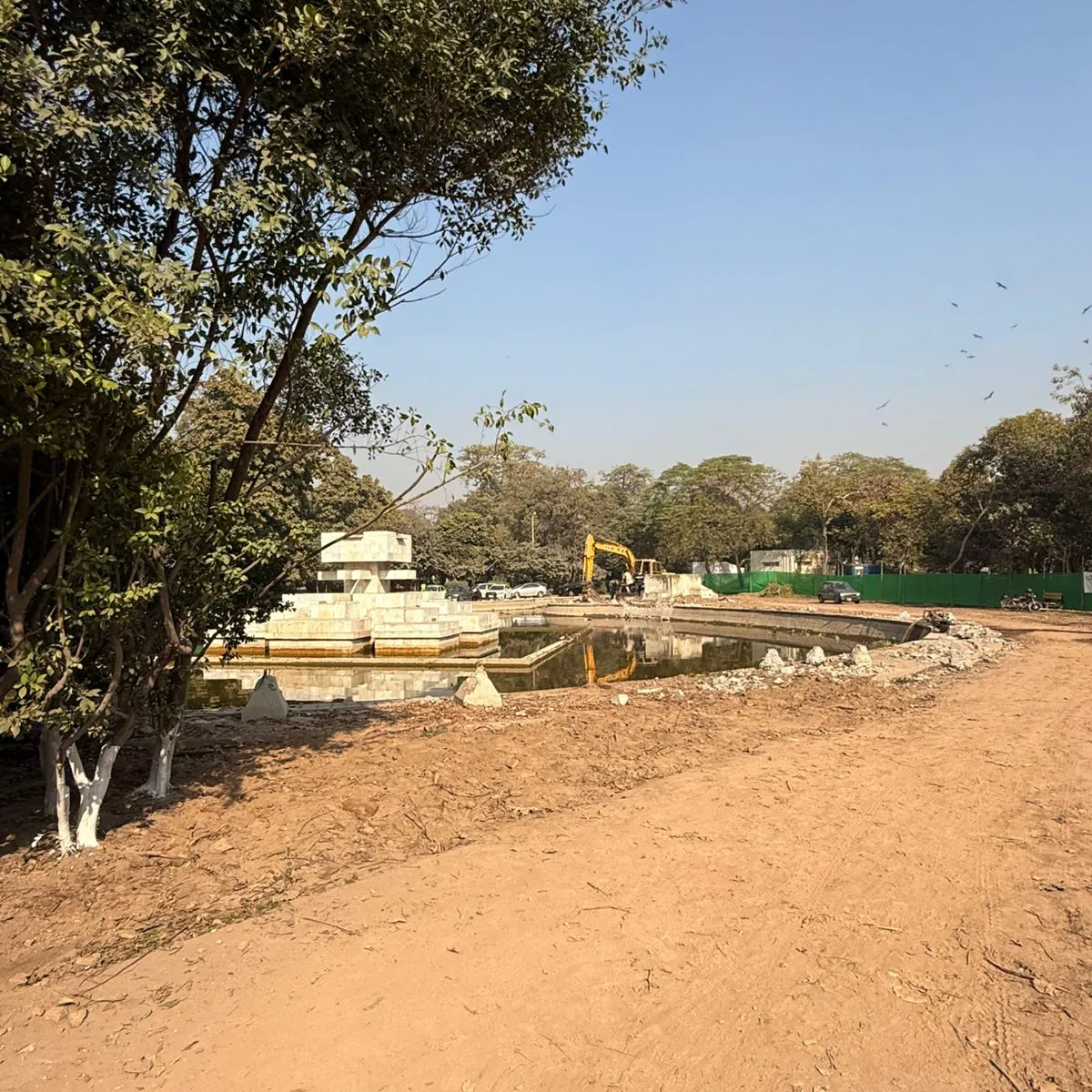
You can imagine, then, how mortifying it was for us to finally reach Nasir Bagh at the end of our Mall Road tour, only to find a section of one of Lahore’s few surviving gardens and the ‘Lungs of the Lower Mall’, being razed to the ground in order to be converted into an underground parking plaza.
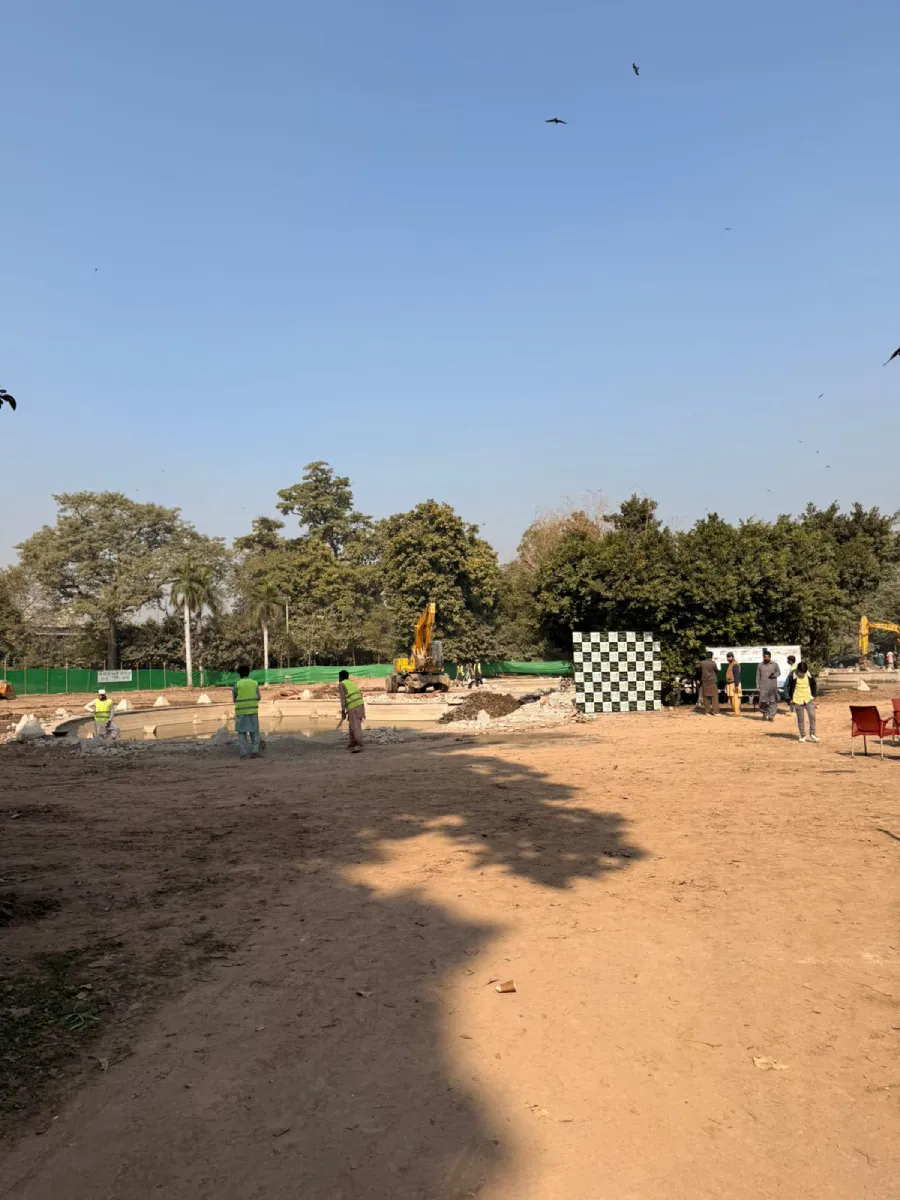
The serene pond where ducks once played and fought over leftover sandwich crumbs was being drained; the small bridge over the water where visitors stood for selfies was no longer there; over a hundred trees that people picnicked under have been removed, to be replanted elsewhere; the central fountain was being ‘moved’ inconsiderately by carelessly driven cranes to “somewhere else in the city, not sure where yet”, according to Lahore Development Authority’s (LDA) official monitoring the site. An entire ecosystem, a home for birds, shade for pedestrians and one of the few breathable corners and living heritage of Lahore, ripped overnight.
“But why? How can you do this!” protested the students, the hunger pangs and tiredness sidelined in the face of this brazen erasure. As budding architects, urban planners and most importantly, as citizens of Lahore, they were heartbroken and angry watching their city, their home, being destroyed without their knowledge, let alone consent. But, this is, sadly, nothing new — especially for this corner of the Mall.
Nasir Bagh was originally called the Band Stand Garden, where performances took place during the British Raj; it was later renamed Gole Bagh after Partition and became the site of political rallies and protests. Due to its central location and proximity to several universities and major landmarks, it remains a popular spot for rest and recreation.
During the British Raj, the Mall Road was designed as a wide, two-way boulevard to accommodate cars and tongas, but it was also designed to support walkability, with pedestrian infrastructure such as broad sidewalks, large shade-giving trees and recreational spaces for both leisure and rest. Much has changed since then. Now the Mall Road is jammed with multiple car lanes on either side, the once tree-lined road dividers narrowed to half their original size to increase space for car parking in the sidewalks. Even local food vendors who added a little bit of humanness, pushing their carts up and down the Mall, dexterously preparing sittay and shakargandi for the extensive student and legal community, have been cast out by provincial anti-encroachment laws. It is no longer a promenade, but pandemonium.
Lahore, once known as the City of Gardens, marked with large green spaces, tree-tunnels and streets with overhead canopies, now tops the list for The World’s Most Polluted City. This is due to rapid urbanisation, population growth, as well as politically incentivised planning and ‘development’ that prioritises concretising the city, rather than preserving it. In the last twenty years, Lahore has lost 75 percent of its tree coverage as per Afforestation Lahore, creating ‘heat islands’ across the city, with the Mall Road becoming a primary hot spot (literally).
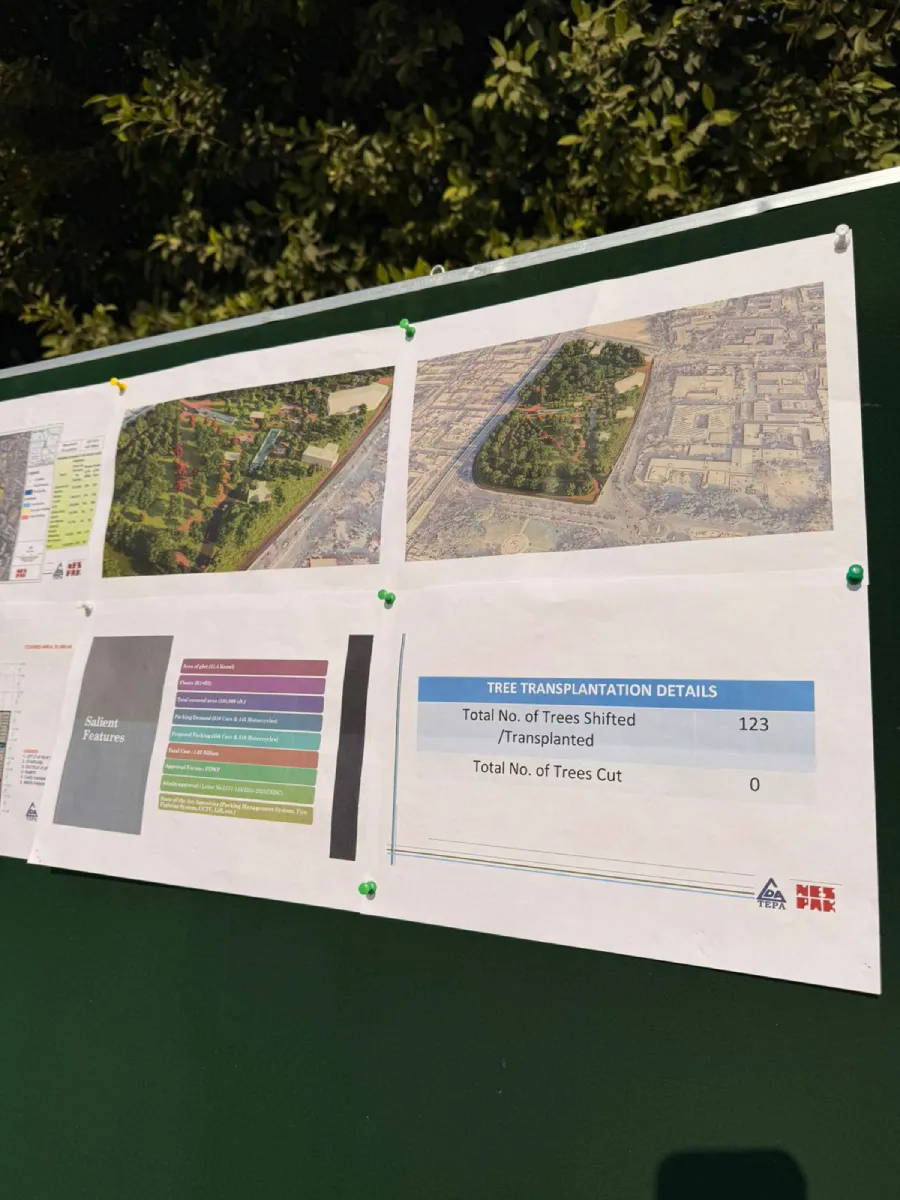
Turns out that as part of the Lahore Authority for Heritage Revival (LAHR) established by the Punjab Government, a parking plaza is the proposed solution to traffic congestion and vehicular pollution along Mall Road and two other roads flanking the park, with a European-inspired town square, in place of the lake, for pedestrian use. Under the patronage of PML-N President Nawaz SharifReplace with your link text, this is the first of a “city-wide project to make heritage sites more accessible, while simultaneously combating traffic jams and smog created by fumes of cars,” with Neela Gumbat and Data Darbar being the next targets, reported the Traffic Engineering and Transport Planning Agency (TEPA) official on site.
After a decade of Lahore constantly being the most polluted city in the world, it is common knowledge that low-quality and contaminated fuel being used in cars is the biggest culprit for smog; changing that would immensely mitigate pollution. As would providing better, more accessible and affordable public transport covering a wider route, and policies that limit vehicular purchase and usage. However, if LAHR insists a parking plaza is the best way forward — and if we accept that additional parking could be helpful and a purpose-built square encourage pedestrian usage — the question remains: Why Nasir Bagh?
Renowned architect Raza Ali Dada — who has incidentally been advocating for pedestrianising Mall Road for years now and has already researched, prepared and proposed an extensive yet scalable plan for it — says, “Firstly, you cannot solve parking with a plaza. Secondly, parking facilities should be made on side and back zones and avoided near special zones. Mall Road is a special zone, and Nasir Bagh is a very special zone.”
A European-style square is irrelevant and futile for a land, climate and people that are nothing like Europe, unless it is merged with traditional concepts and put into a local context for the user. Planners and developers need to modify their understanding of and approach to public and green space by centralising design around native habitats and resident environments, by working with nature and ecology, not against it.
Nasir Bagh was originally called the Band Stand Garden, where performances took place during the British Raj; it was later renamed Gole Bagh after Partition and became the site of political rallies and protests. Due to its central location and proximity to several universities and major landmarks, it remains a popular spot for rest and recreation. Just two years ago, the Lahore Biennale Foundation (LBF) and Parks and Horticulture Authority (PHA) joined forces to revamp the park by improving its landscaping, adding facilities and eateries, and converting the derelict colonial military barracks there into a first-of-its-kind, underground contemporary art museum. Now, much of the area is nothing but rubble. How ironic, to destroy heritage sights in order to revive heritage-use, to cut down green spaces in order to cut down pollution.
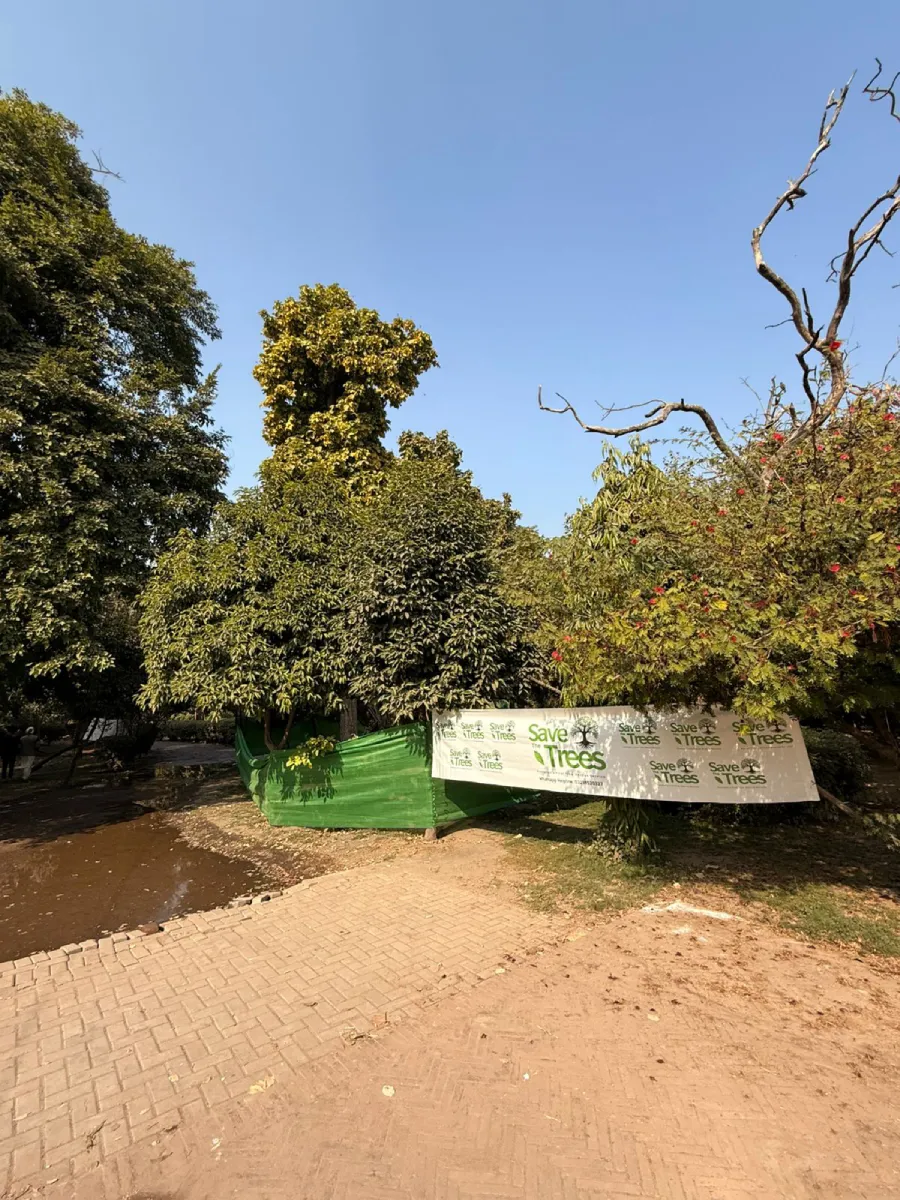
LAHR has plastered informational posters and benefits about the project on site (although you cannot take them home!), starting with a life size banner from Save The Tree’s organisation claiming that all 127 trees cut for the plaza have already been transplanted in other areas of the park, but at the time of writing this, there was no evidence that an Environmental Impact Assessment (EIA) — a legal requirement for any public project in the city — had been conducted. It is also unclear on what policy is driving this agenda, what larger planning approach was used and what background information considered to plan this.
Regardless, the situation is simple to comprehend: in a city suffering from a plethora of climate woes, including extremely high temperatures, the more trees and vegetation there is, the more shade and respite from heat you get, the more carbon sinks for the sequestration of pollutants like car emissions exist, the more biodiversity you support and therefore, the more pedestrian mobility and usage you encourage. A European-style square is irrelevant and futile for a land, climate and people that are nothing like Europe, unless it is merged with traditional concepts and put into a local context for the user. Planners and developers need to modify their understanding of and approach to public and green space by centralising design around native habitats and resident environments, by working with nature and ecology, not against it.
In a day and age where cities worldwide have reached their threshold for built environment and strict concepts of ‘city planning’ are being replaced with more fluid ideas of ‘city making’, there arises a tug-of-war between designers and users, begging the question: “Who makes the call?”
Through my work at Rah Cities, I have found the answer to be simple (and always the same): the community does.
Participatory architecture and community driven urban transformation is a necessity. Ask the users who experience the space first hand: What do you want? What do you need? What do you think?
Successful cities are built on public engagement and local knowledge, by giving citizens rights and access to their city. Not by government officials sitting behind closed doors in temperature-controlled offices that they are escorted to via VIP routes, who think they know what the people need and want because they saw it work well or look good in another city.
A model example of this is the internationally acclaimed Barefoot Social Architecture by Yasmeen Lari, who proves that community participation in development leads to more socially cohesive spaces, cultural expression and economic vitality. Examples include Angoori Bagh Housing Scheme of 1973 for low-income families, the research for which started with a “A public meeting held with the people (…), to discuss the kind of housing required. A couple of thousand men and women attended the meeting”. The brief and design were formulated between future occupants and the architect, proving that quality housing could be delivered through good design, cheap materials and local workforce. Several other organisations — such as the Lahore Biennale Foundation, Afforestation Lahore, Placemaking Pakistan, Walled City Lahore Authority — are also employing more interactive, inclusive and interdisciplinary approaches in order to create durable and dynamic urban environments across the city.
Successful cities are built on public engagement and local knowledge, by giving citizens rights and access to their city. Not by government officials sitting behind closed doors in temperature-controlled offices that they are escorted to via VIP routes, who think they know what the people need and want because they saw it work well or look good in another city.
Alas, many underpasses and signal-free corridors scaled across Lahore in recent years have shown us that concrete is not the solution to the problem. Highways and high-rise buildings are not development or progress, rather sheer negligence towards a city already choking on pollution and towards neighbourhoods already short on public space. Nasir Bagh is not just the loss of a park and destruction of one of the oldest public green spaces of Lahore, it is an erasure of Lahori identity. It is a crime against Mall Road — and the city at large.
As Nasir Bagh protestors, led by environmental activist Abuzhar Madhu, correctly said: “We are here, to protect our public space because it belongs to us, not to private interests and not to profit. This is our shade, our clean air. This is our historical garden, our shared memory. These are our lungs. And our right to breathe.”
Let Lahore Live!
All photos courtesy of the author.
Bisma Ahmad is an urban practitioner based in Lahore, interested in researching the spatial and curatorial potential of cities. She is the founder of RAH, an organisation that works across urbanism, arts and culture to develop creative and collaborative approaches to city-making. Her practice focuses on understanding Lahore as a complex and layered set of spaces and proposes interventions in the public realm for the betterment of community and the environment.