I could begin with my earliest memories of my uncle’s lands in Vehari, a gentle horse named Sava and a stainless steel spittoon. With its thick, velvety coat and bristling spunk, Sava was a pedigree dancing horse and stank of heat and manure. If Sava’s ceremony summoned notions of feudal protocol and prestige since, after all, he resided in a stable full of dancing horses, the spittoon, a simple silvery thing with thin filigree, signified to me the highest order of sloth.
Why can’t people go and spit in a bathroom sink?
This is, of course, also the spittoon of history and tradition, the vessel that Salman Rushdie’s Midnight's Children lavishes with chewed betel and the palpable density of flesh moving through time. It is time, after all, that converts an object of use into a relic. Unlike Rushdie’s mythologised spittoon, however, the ones in Vehari remain stubbornly ordinary—functional objects whose meaning lies not in symbolism but in their quiet extension of history through daily use.
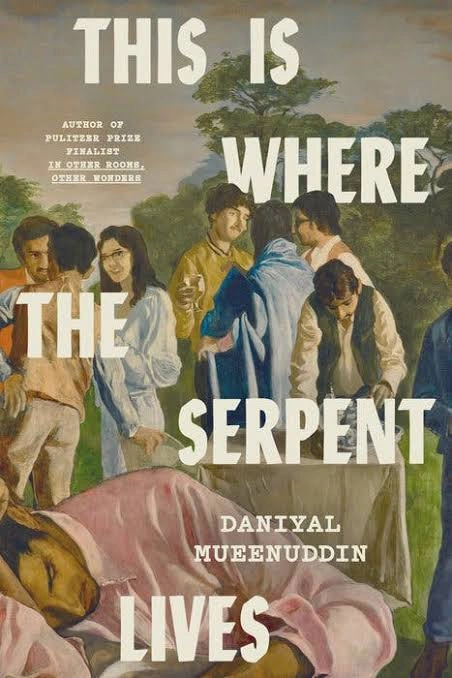
There are no spittoons, nor any stables of dancing horses, in This Is Where the Serpent Lives, yet Daniyal Mueenuddin’s debut novel fashions its own emblems of prestige and sloth. iPhones, foreign degrees, and tiled swimming pools signify a new generation of landowners, figures cushioned enough by inheritance to remain estranged from the very land that secures their authority.
Had there been spittoons and dancing horses, TIWSL’s fictional estates—Dunyapur and Ranmal Mohra—might have dissolved into the familiar iconography of South Punjab feudalism. We have the Pakistan Television Corporation to thank for the durable tableau of earthen pots, woven mooray, and languid landlords framed by dust and dusk. That would have been the easier failure: stereotype, pastiche, the comfort of recognition. Instead, TIWSL’s landscapes commit a subtler, more diffuse error: they resemble the globally affluent, every rich in every city, their torn identities misplacing the novel itself.
Mueenuddin’s undertaking is ambitious. He maps the fluctuating yet fundamentally predictable relationships between feudal elites, their dependents, and the bureaucratic adhesions that bind land to power. Across the four interlinked novellas that compose the novel, prestige and sloth operate as twin motors of drama.
‘The Golden Boy,’ set in Rawalpindi between 1955 and 1979, follows Yazid, an orphaned tea boy who fashions himself after the affluent schoolboys he once served, attempting to insinuate himself into their class. His ascent, however, is undone by the paranoia of an older, jealous maidservant.
‘Muscle,’ set in 1988, follows Rustom Abdalah, newly returned from the United States to resuscitate his father’s squandered estate. Committed to an American-inflected civility, he resists the brute logic underwriting rural power, only to discover that reform without intimidation is untenable. Reluctantly, he turns to hired muscle to discipline rivals and reassert the estate’s authority.
‘The Clean Release’ extends this world of unenthusiastic inheritors. Framed by a night of drinking and reminiscence between Rustom and his second cousin Hisham Atar in 2005, the novella reconstructs the origins of Hisham’s marriage to the cosmopolitan, imperious Shahnaz between 1972 and 1976. American-bred and educated, Shahnaz first appears as Hisham’s brother’s girlfriend; their illicit affair precipitates the brother’s permanent departure.
If the first three novellas read like undissolved fragments of a centrifugal whole, ‘This Is Where The Serpent Lives’—the collection’s longest and most fully realised section—demonstrates Mueenuddin’s patience with narrative crescendo. It centers on Saqib, a teenager taken in by Yazid, now the Atars’ most trusted retainer. Spanning a decade (2003–2013), the novella charts Saqib’s slow ignition: one fateful night kindles in him an insatiable longing to inhabit the wealth, refinement, and authority of his masters, Hisham and Shahnaz. Their benevolence extends to trust, but never to forgiveness—a distinction Saqib fatally misrecognizes. In mistaking proximity for entitlement, he accelerates his own undoing, culminating in the novel’s most searing act of violence.
Had there been spittoons and dancing horses, TIWSL’s fictional estates—Dunyapur and Ranmal Mohra—might have dissolved into the familiar iconography of South Punjab feudalism. We have the Pakistan Television Corporation to thank for the durable tableau of earthen pots, woven mooray, and languid landlords framed by dust and dusk. That would have been the easier failure: stereotype, pastiche, the comfort of recognition.
Instead, TIWSL’s landscapes commit a subtler, more diffuse error: they resemble the globally affluent, every rich in every city, their torn identities misplacing the novel itself. Their distinguishing features are not turbans or stables but Ivy League degrees, poolside cocktails, imported cheeses, and English accents so meticulously burnished that even Urdu recedes, let alone Punjabi or Saraiki. One begins to wonder where, precisely, to situate the Atars and the Abdallahs. Are they closer to the Khichis, the Gardezis, the Daultanas, the Peerzadas—those names that still tether power to soil? Or are they the new custodians of capital who prefer housing societies and petrol pumps to wheat and cane? Would they parcel the land into contracts, liquidate it, outsource its care?
The West is less a location than a permanent horizon of desire. So totalising is this imagined elsewhere that when Hisham meets a Frenchwoman, she enters the narrative not as French, but simply as “a foreign woman,” marked by a backless silk jumpsuit that “a Pakistani woman wouldn’t venture upon.”
The answer is curiously indeterminate. They are neither agrarian patriarchs nor fully urban developers—a generational anomaly, presented almost as an emergent norm. What they are, unmistakably, is Westernised: products of a cosmopolitan formation so reluctantly embedded in Punjab that even three or so decades back from the West have not given them a sense of home. They are, in other words, what Mueenuddin himself knows.
Consider Rustom, who shares his alma mater—Dartmouth College—with the writer, along with the familiar narrative of return: ancestral lands imperilled by conniving munshis, opportunistic policemen, and villagers who read in him the softness of a foreign education, the green naïveté of the gora-adjacent heir. In a gesture toward old editions and translations, Mueenuddin supplies a list of characters in order of appearance, though such scaffolding proves unnecessary. Beyond the first novella, all characters begin to blur and feel alike.
The rich are certainly all the same. Late at night, usually drunk, Rustom and Hisham indulge in nostalgia for their youth. Because that youth unfolded in the West—where Rustom left behind his American girlfriend, where Hisham first encountered the then-radiant Shahnaz—their longing is geographically fixed. The West is less a location than a permanent horizon of desire. So totalising is this imagined elsewhere that when Hisham meets a Frenchwoman, she enters the narrative not as French but simply as “a foreign woman,” marked by a backless silk jumpsuit that “a Pakistani woman wouldn’t venture upon.”
A Pakistani woman, unlike Shahnaz, that is. Having spent more years in the West than her husband, Shahnaz is said to view the world “through the lens of her Western politics and experience.” She listens to Bach; it is not enough that this elite is elite by Pakistan’s measure, in which case she could have listened to jazz or rock music, but no, this is an elite by Western standards. Maybe it is this cultivated cosmopolitanism that enables her to render Hisham a “hapless mate,” outmanoeuvring him through a steady choreography of calculation and charm, the old, familiar tale of wives playing their husbands like a master puppeteer.
If Rustom, Hisham, and Shahnaz are the West, their servants, Saqib and Yazid, all aspire to possess them. Saqib’s modest ambition, once limited to achieving Yazid’s stable proximity to power, mutates at a party hosted by the “foreign woman,” when he stumbles upon Hisham performing oral sex on their hostess, Sonya. Like poorly-written erotica, the scene arrests him into stunned voyeurism; he hovers at the threshold, intermittently touching himself, astonished by what he had “never thought a man might do to a woman in real life.”
That is, until 2013. By then, Chinese smartphones would have saturated the villages, delivering unmediated access to “Western porn.” Since porn alone is not enough, the phrase does some heavy lifting here: Western porn is the dirtier, sexier porn, readily overtaking its implied counterpart, the forgettable Eastern porn.
Gender, too, succumbs to flattening. Older women—Mai Viro, Gazala’s grandmother—are dispatched as “ancient crones,” stripped of interiority. Younger women are rendered through synecdoche, most insistently, their feet. Yasmin lounges with her “feet bare and up on the bed.” Rustom contemplates Nisa’s long feet and thick ankles, comparing them unfavourably to his American girlfriend’s “delicate” ones. Shahnaz recurrently sits with her “feet tucked under,” while Saqib’s gaze fixes on Gazala’s “little foot” as she balances sidesaddle on her brother’s bike. The motif accumulates with peculiar intensity, like the feet of oriental tellings, a fragmentation of the body, the feet being all that can be seen, at the woman’s expense.
The men, by contrast, are defined less by fragmentation than by repression, a force so heady that it cuts across class. Their sexuality grows as acute discomfort, a raw current that evokes colonial anxieties about the native man’s unrestrained excess, barely tempered by Western veneers. Consider how Yazid becomes conscious of his proximity to his best friend’s sister, Yasmin—a “rising awareness so illicit” that he avoids their house altogether. Rustom registers Nisa’s nearness with similar unease, “uncomfortably aware of her proximity, of her rounded biscuit-coloured bare arm ...”
Hisham, too, feels Shahnaz as a charged presence while she is still his brother’s girlfriend: “That was when he truly became aware of her as a woman, and then it wouldn’t leave him.” Saqib, likewise, “prickles with consciousness of her (Gazala’s) body” as she sets dinner for him, not unlike their first meeting in the fields at night when “he could sense her body as he had never sensed it before.”
Is this romantic—these young men craving the touch of women they barely know, tingling simply in their presence? As such, there is no romance in TIWSL. In ‘The Golden Boy,’ Yazid falls in love and later returns to avenge his lover’s rape by the resident goon—he does not marry her. Yazid, who lost his virginity to the “greedy hands” of a prostitute, knows no more about interacting with girls, especially “respectable girls,” than Hisham, whose emotional apex in college was a “sentimental friendship… teasingly platonic for the moment” with a female undergrad.
For readers familiar, Mueenuddin deploys a very similar interplay of gender, class, and land in his critically acclaimed debut, In Other Rooms, Other Wonders (2009). Seventeen years later, one might expect the intervening time to have altered his vision, but evidently, transformation is not his métier. Even the country, traced across 1955 to 2013, almost as old as itself, registers little sense of change. The passage of years in the countryside seems largely immune to the larger chessboard of politics, or even the shifting currents of culture.
Perhaps this is unfair, for the author has little say in how the work is received, but TIWSL foregrounds the recurring crisis of writing Pakistan: the thick tension between fact and fiction. In Mueenuddin’s case, all creative liberties are almost universally read not as acts of imagination but as evidence of acute observation.
For the most part in TIWSL, Mueenuddin succeeds in keeping his characters suspended within a feudal system that feels both timeless and truncated, excised from historical contingency yet still conversant with mobile phones, new seed technologies, and other markers of modernity. This could explain why the absence of real-world interventions—like the swelling presence of the Anjuman-e-Mazareen Punjab after 2000, or repeated episodes of martial law through the decades—registers only faintly on the page. None of the characters, after all, exist fully in flesh; they inhabit a world where social hierarchies and bodily desires are more archetypal than materially grounded.
Perhaps this is unfair, for the author has little say in how the work is received, but TIWSL foregrounds the recurring crisis of writing Pakistan: the thick tension between fact and fiction. In Mueenuddin’s case, all creative liberties are almost universally read not as acts of imagination but as evidence of acute observation. Take, for instance, Patrick Gale’s praise in The Guardian: a “shattering portrayal of Pakistani life.” Pakistani life, as it is presented, is so opaque, so incoherent in its pleasures and transgressions, that any narrative deficiency is attributed to the society itself, rather than the novel. Gale acknowledges the absence of a female perspective as “a minor quibble,” resolving it by suggesting that perhaps Mueenuddin is deliberately highlighting a culture in which the male voice predominates.
Similarly, Karan Mahajan, writing for The Atlantic, frames the novel’s sprawling narrative not as a structural failing but as a reflection of Pakistani society itself—a pitfall of content that mirrors the complexities, hierarchies, and contradictions of the world it depicts. Recalling Mueenuddin’s earlier story about an electrician who manipulates electricity meter readings, Mahajan asks, “How does he (Mueenuddin) know so much?”
Or, as Lucy Popescu writes for The Observer, “Mueenuddin, who lives between Oslo and his farm in Pakistan’s South Punjab, clearly knows this milieu.” One cannot easily contest this Pakistani life or milieu, even though it unfolds largely in Punjab and still cannot by any measure be dubbed “Punjabi.” Perhaps the challenges of this novel are simply the shortcomings of the write-what-you-know maxim: if he is to write what he knows, is he condemned to retell the same stories? In which case, if all observation is tested against the grain, what remains is scarcely a handful of imagination.

Manahil Tahira is a Karachi-based journalist and writer whose work moves between fiction and nonfiction, tracing the intersections of bodies, spaces, visuality and technology. Formerly desk head of Lifestyle at The Express Tribune, their creative writing has appeared in Arzu Anthology, Fahmidan Journal, Lakeer, and is forthcoming in The Aleph Review (2025). They are also a Non-Fiction Editor at South Asian Avant-Garde (SAAG) magazine.