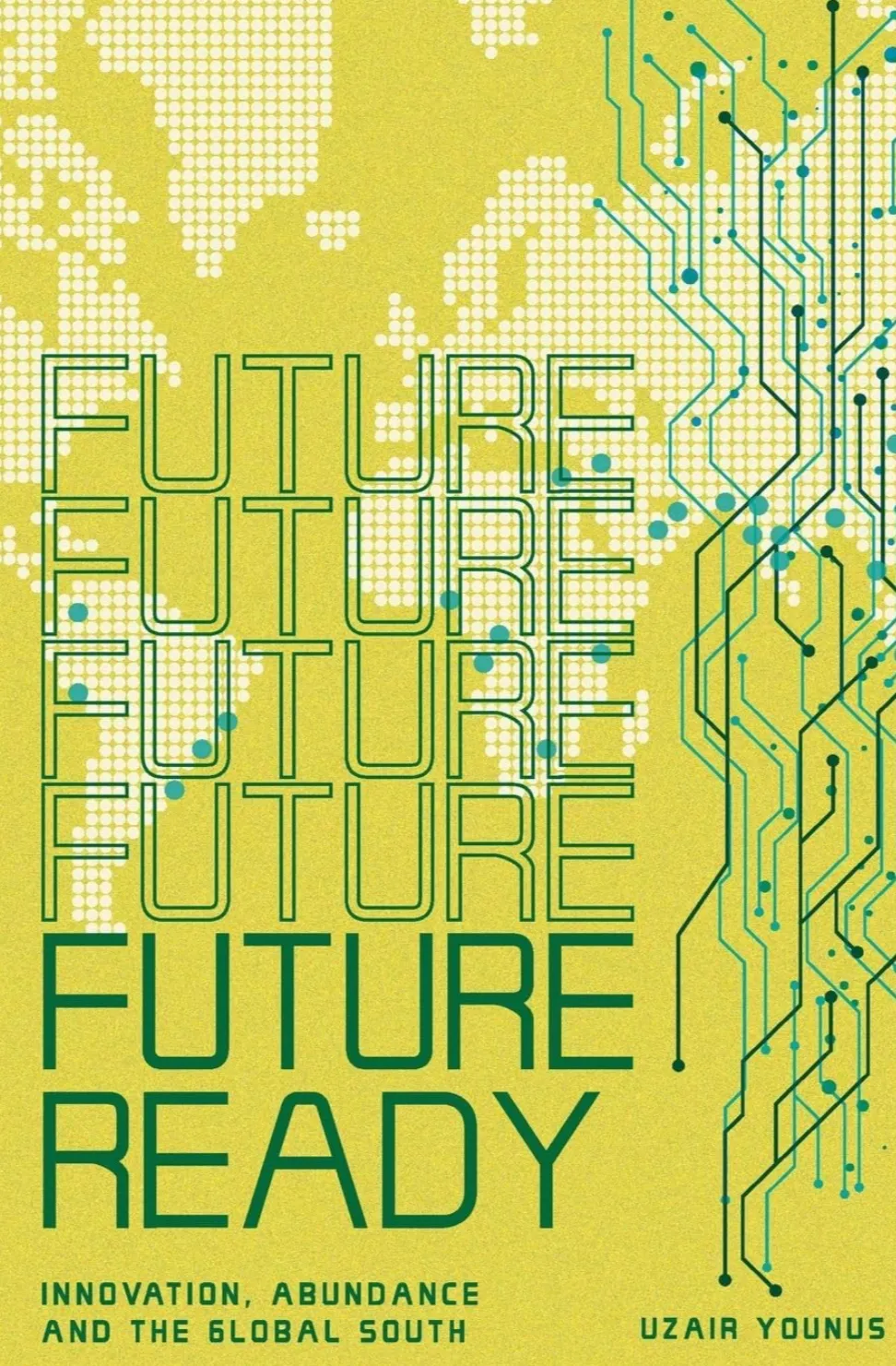
I remember, despite a notoriously bad memory, the first time I came across Uzair Younus — it was on a podcast with Zafar Masud, where they both discussed how to clamp down on the ever-animated Cash in Circulation (CinC). The backdrop to this was an excellent commentary Zafar had written on CinC. Since then, I have been following Uzair and eagerly look forward to every article he writes and podcast he produces, each full of delightful nuggets that span the political, social and economic realms.
Now, Uzair finally lets his thoughts undulate across a full-fledged book. The book aptly weaves a historic tapestry, showcasing the cataclysms the world saw by disgorging developments (and cross-infestation of technological tectonic innovations) across different sectors: from energy to mobility, to the paper, agriculture and glassmaking industries; from human computers to pocket-sized supercomputers. The world has witnessed astronomic pandemoniums, right from the Industrial Revolution to today’s AI-focused world.
The change is drastic and evident: just see the rooftops of houses and you’ll see the shiny surfaces of PVs (photovoltaics), something that our eyes were not acclimatised to five years ago; the ever more powerful phones that are cropping up (compare them with the fat, old, box-like desktops of some years ago); or even this, the reading of another’s thoughts easily on myriad devices.
The book aptly weaves a historic tapestry, showcasing the cataclysms the world saw by disgorging developments (and cross-infestation of technological tectonic innovations) across different sectors: from energy to mobility, to the paper, agriculture and glassmaking industries; from human computers to pocket-sized supercomputers.
The basics he lays out are quite simple and foundational for our country (though the book presents its knowledge to the Global South in general, with the author’s interest in Pakistan in particular): more technological convergence leading to more innovations, more demand, more supply, and self-enforcing loops, ergo more income, more capital, more investment, leading to more productivity, and so on. An industry that was struggling with four hours of load shedding — four hours of productivity lost due to the grid’s imperfect modus operandi — is now working even during those four hours, leading to more income and productivity, with many more industries like this buying PVs, leading to higher demand and thereby more competition, supply and innovation.
There is no denying this phenomenon, but this is not the whole vista, rather a textbook outlook. Uzair had a quite sugarcoated (and parochial) lens towards history. Yes! The Industrial Revolution ameliorated our weltanschauung: spurring productivity, blitzing high costs of living, connecting the globe through cheap and sturdy mobility and magically coming up with technological advancements — in energy, agriculture, industries of every sort and kind — all of this is true. But this is the total pie, and not the ill distribution amongst the players (read: exploiters and exploited).
There should have been a dedicated chapter on this, both locally and globally, rather than outright praise of capitalism. The top 10% owns three-quarters of global wealth, while the bottom half holds only 2%, as per the World Inequality Report 2026. Resultantly, questions like: how the past’s and present’s blind drive to maximise profits is causing skewed technological shifts (and by extension, infusing vitality to techno-capitalism), leading to inequalities, monopolies and militarism, are some poignant discussions that were largely missed.
Furthermore, even the situational analysis, comprising historical analysis (how we came here) and gap analysis (what we need to do to achieve our objectives), is innocuous and bland. It presents an abundance of historical facts with a horizontal analysis of data/facts (change YoY), sans vertical analysis/disaggregation, and even that is offered without problematisation, that is, there is no substantial attempt to identify and assess bottlenecks and their root causes in the status quo. Instead, the focus remains on solutions to symptoms, regurgitated as insights, while the emphasis on addressing underlying causes is missing.
In a way, what T. S. Eliot called “the historic sense,” in his famous essay, Tradition and the Individual Talent — “which is a sense of the timeless as well as of the temporal and of the timeless and of the temporal together, is what makes a writer traditional. And it is at the same time what makes a writer most acutely conscious of his place in time, of his own contemporaneity”— is lacking. “The pastness of the past,” is present in the book, but its transcreation within the present, with all its new knots, is absent. The bottlenecks, often not discussed extensively in the first place, are assumed to resolve themselves through the mere adaptation of technological advancement, whereas these very bottlenecks are precisely what leave mass adaptation hamstrung.
For instance, he argues that PV, with domestic consumers, as well as industries acting as micro power producers, along with Better Energy Storage Systems (BESS), is benefiting from the convergence of technology and the demand-supply continuum. Prices are declining constantly, thereby making the unreliable national grid more and more expensive. And therefore, the government should support this mass adaptation of this new technology to diminish reliance on fossil fuels. But this is not something novel — everyone knows this. Even WhatsApp uncles, despite lacking finicky, data-driven knowledge, know this. Where is the critical fleshing out of bottlenecks? And the root causes of them? Or does the author think that everyone, including the government, is unaware of this technological advancement and thereby, a constant plunge in prices?
Similarly, in the author’s prescribed reparation of CinC, from where it all started, he rightly identifies the states’ budgetary deficit, emanating a crowding-out effect for private credit. For the financial revolution to transpire, we need digital identity, internet and bank accounts — all linked — thereby axeing CinC, increasing capital accumulation and enabling banks to create more credit.
He states the symptom (dependency on fossil fuel for power generation), as well as the solution (PV plus BESS, given the zero marginal cost and scalability). What he misses are bottlenecks: surplus capacity (and the undeniable capacity payments), unreliable grid, duck-curve effect, uniform tariffs and whatnot; and root causes: gratuitous governmental benevolence, pathetic governance in SOEs, inward-looking regulator, weak rule of law, and not-so-charming grid and socioeconomic factors (see latest HIES) not allowing everyone to buy the PV.
All the more, there is a deep political economy prolifically scaffolding itself as an impediment against PV: viscous regulator; IPPs — owned by elites and supported by, using Asad Rahim’s diction, the unity regime; and inefficiencies of SOEs (DISCOs, NTDC, and whatnot), causing T&D and commercial losses. Everything is bestowing bits to the chaotic mess, benefitting a few and making many worse.
Similarly, in the author’s prescribed reparation of CinC, from where it all started, he rightly identifies the states’ budgetary deficit, emanating a crowding-out effect for private credit. For the financial revolution to transpire, we need digital identity, internet and bank accounts — all linked — thereby axeing CinC, increasing capital accumulation and enabling banks to create more credit. Pakistan, however, struggles with the bank account problem (just try opening an account, and you’ll see the lag).
Again, the question remains: how exactly can we achieve this financial revolution? What are the hurdles, for instance, inter alia: institutional clarity (uncertainty about responsibilities, with no single lead institution); conceptual gaps (departments having different understandings of digitisation); weak compliance and limited ownership (complex procedures and low technical capacity weakening monitoring); co-ordination issues (poor co-ordination within and between departments); and payment scheme challenges (merchants may need to accept digital payments, like QR codes, but penalising non-compliance could increase costs or harm business operations). How do we address them? They are not even mentioned.
Then come some bland GPT-esque remedies, with no reasonable mention of the political economy underlying the Pakistani macroeconomic bloodbath, and how to deal with it innovatively — to be fair, in Chapter 10, he mentions the need for a decentralised system of governance, the benefits of it, the ills of the centralised system of the Industrial Revolution, and also claims how technological disruption weakens centralisation. He says, “From solar and wind power systems equipped with battery storage to modular manufacturing processes and disintermediated media environments, the convergence of technologies is already weakening the control exerted by centralised, highly bureaucratic systems.”
On the contrary, I think, the government can negatively affect PV adaptation through measures such as the latest prosumer regulation (shifting from net metering to net billing), stifling efficient industrialisation through subsidy-laden policies that favour inefficiency, and manipulating decentralised media via legally ambiguous structures (see the entire Imaan Mazari fiasco).
Apparently, we are in a causality dysmorphia, where innovation from the bottom up is overpowering the top-down structure. Yet the same author claims, “societies require the right type of systems to promote innovation, adopt new technologies, and achieve higher productivity” — now we are veering antithetically.
Lastly, it could be contended that the book was never meant to be a scathing diagnostic analysis of Pakistan’s ailments. However, that is precisely my contention: if this is not an in-depth exploration, then what is the raison d’être of the inked pages anyway, apart from informational mimicry?
This symptom-centric discourse is not new. Yes! Our nervous system is broken, as Atif Mian famously says; however, it is the marring of the system in totality, through cronyism, corruption and political manoeuvring, which should be named as the heart of many, if not all, maladies. Nobody is stupid. Mandating Monte Carlo simulations for every governmental decision will solve nothing. Unless we identify who exactly benefits from the exploited system and nip the evil in the bud, all remedies will remain cosmetic.
The disruption brought about by the convergence of technology is something we should welcome, but without structural (MLDAs’ favourite word) changes in the backdrop, the realisation would remain a far-flung fantasy. Without a smooth road, even a car running on water cannot move. Similarly, in the digital space, YouTube being banned during its peak years is something our content creators, regardless of their creative virtuosity, often lament when comparing their low visibility to that of Indian creators.
Furthermore, the disruption we all talk about is not utterly epiphanic; there is always a learning curve behind it. Without educational buttressing, even application, let alone invention, cannot be achieved. Let’s not forget, NADRA was once employing high-end Apple iMacs with pirated Windows 7. The author has largely circumvented the broader panorama of the country’s deeply flawed education system, from OOSC to the feeble startup culture (ORICs, NICs, and BICs still in nascency), in the emanation of his blueprint for the colossal national change.
Lastly, it could be contended that the book was never meant to be a scathing diagnostic analysis of Pakistan’s ailments. However, that is precisely my contention: if this is not an in-depth exploration, then what is the raison d’être of the inked pages anyway, apart from informational mimicry?

Furqan Ali is a Peshawar-based researcher and writer on governance, climate, gender, finance and literature; he is also the co-founder of Policy Club. Furqan can be reached at [email protected]