Prisons and their inmates have too real an existence not to have a profound effect on people who remain free,” Jean Genet writes in Miracle of the Rose. Freedom, in Marlon James’ The Disappearers, is a similarly unstable proposition. His sixth novel, shortlisted for this year’s Booker Prize, returns four years after the myth-drenched kingdoms of Moon Witch, Spider King—the second volume of his Dark Star trilogy—to a Kingston of May 1988. Reality, in James’ hands, proves no less strange than myth: a sobering shapeshifter of a novel, it takes the capital city itself as its first and most capacious enclosure.
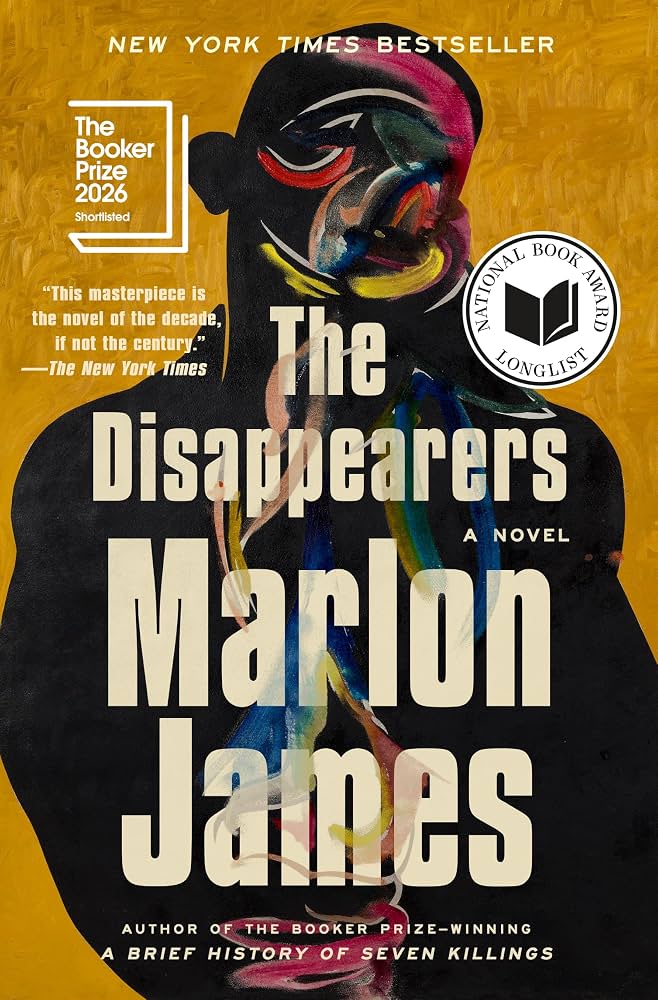
Eight gay men are rehearsing a play in secret: John Herbert’s 1967 prison drama Fortune and Men’s Eyes, about a young man’s brutal initiation into the sexual hierarchies and coercive order of a Canadian prison. James’ 640-page polyphonic novel unfolds in five parts, moving between years, cities, letters and interview transcripts, though it begins with the diary of Edmond “Eddy” Porteous, a “white-ish” Belgian-Jamaican college student. Wry, self-conscious and expository, Eddy’s entries record the hesitant camaraderie taking shape around the rehearsals alongside the more sprawling business of his libido, which ranges freely between college and the bedroom only to arrive, again and again, at the knowledge of danger. The mall, that new frontier of capital and sociality, is where you hook up; it is also where mobs come to lynch you, and whoever tries to shield you. “Jesus, I don’t think about it a lot, but people want to kill us. Us, I’m a part of an us that people just want to beat to death.”
The attackers’ narrative voices place the reader inside the vernacular of hatred: its jokes, prejudices, evasions and inherited convictions, the small accommodations by which brutality becomes thinkable, and then ordinary.
The foreboding gathers toward the novel’s turning point: a ghastly mob attack during a rehearsal, carried out by twelve men known as the Blackjacks. One man is stabbed to death; another is blinded. Everyone but Eddy, who has skipped rehearsal that night, is grievously assaulted. Two will later disappear without a trace. The section is narrated by the attackers themselves, a mosaic of bleak first-person confessions and musings from colluding cops and men variously religious, unbelieving, foul-mouthed, white-hating, women-beating, closeted and diasporic, with fulsome praise for a homophobic reggae singer Streggeh Don threaded throughout. The attackers’ narrative voices place the reader inside the vernacular of hatred: its jokes, prejudices, evasions and inherited convictions, the small accommodations by which brutality becomes thinkable and then ordinary.
The Disappearers is less interested in violence as an aberration than in the conditions that make it ordinary.
As in so much of James’ fiction, violence is lodged in the flesh. AIDS hangs over almost everything, moving with grim permeability between uptown and downtown, the straight and the gay, the godly and the ungodly, turning proximity itself into a source of paranoia. The carnage is too graphic to be easily deflected, and yet it is precisely the waywardness of the flesh—its appetites, allegiances and hostilities—which makes The Disappearers so difficult to contain in a review. Its desires are promiscuous; so are its antagonisms. To risk an honest account of either may be to risk something of oneself, literally and figuratively.
Perhaps that is because The Disappearers is less interested in violence as an aberration than in the conditions that make it ordinary. The novel is not a prison story, but its Kingston is so thick with the sediment of postcolonial, religious, class and sexual anxieties that the city acquires a carceral logic of its own, its inhabitants suspended in a time of perpetual imminence. “Everything is about to happen. That’s how we live, everything promising to happen or threatening to happen, but not a fucking thing happens, and you find yourself waiting for so long you forget what you waiting for,” Eddy writes.

Like the 2015 Booker-winning A Brief History of Seven Killings, The Disappearers is panoramic in both geography and voice, its story oscillating between ’80s Kingston, ’50s London and 2000s New York and Miami, among other detours. Following the attack, Eddy, wrestling with survivor’s guilt, joins Jordan, another member of the cast, in trying to find those who vanished; the two men eventually split along divergent paths. With a novel like this, there is always a temptation to imagine persecution producing its own compensatory utopia, the vulnerable finding in one another a ready-made fraternity. But the novel has little interest in such consolations. James remains, as ever, breathtakingly attuned to the mercurial workings of social hierarchy: in his Kingston, a dark-skinned woman will hold her tongue when a light-skinned boy accidentally pushes into her, while a mall mob can kill the homosexual and the white oppressor with one stone. “White is the root of all sexual sin,” declares one Blackjack. “It’s sexual sin that birthed the white race in the first place.” Even the suicide of a rich Indian boy is dismissed as a “white thing to do.”
During the mob attack, a policeman reaches for the Offences Against the Person Act, introduced into Jamaica under British colonial rule in 1864. A Pakistani reader may recognise something of this particular afterlife: the colonial ghosts left behind, and the bloodthirsty mobs that have found their own uses for them.
It would be easy to call The Disappearers a novel about Jamaican homophobia and leave it there, except that the violence James describes has a familiar pulse, one that seems to travel rather too easily across borders and decades, even as the novel remains insistently rooted in Jamaica. “We are in the wake of the postcolonial—the post no longer has critical purchase; we are all too aware that we exist in the stranglehold of coloniality,” Saidiya Hartman has reminded us. During the mob attack, a policeman reaches for the Offences Against the Person Act, introduced into Jamaica under British colonial rule in 1864. A Pakistani reader may recognise something of this particular afterlife: the colonial ghosts left behind, and the bloodthirsty mobs that have found their own uses for them.
More than anything, The Disappearers is a ruthless novel, its fleeting moments of joy vastly outweighed by its exercises in terror and violence. Whatever reprieve exists comes from James’ aphorisms and his practiced patience in letting a sentence run its course. Then there is the music, which runs through all five parts with a vitality almost equal to the prose, making it one of the strongest sonic landscapes in recent fiction. “Rock music was the first time I ever felt something love me back,” says one narrator. References to Echo and the Bunnymen, Depeche Mode, Billy Joel, INXS, and New Order pepper the novel with an earnest melomania, tempered by the self-consciousness of a distinct milieu. In this world, the stakes of pop culture are strikingly high; procuring Prince’s Lovesexy—or a stack of men’s magazines, for that matter—can become a matter of life or death. Elsewhere, tracks like The Piña Colada Song become so swiftly woven into the narrative fabric that their absurdity softens into something like tenderness, while the improbable, enduring allure of Booker T. & the M.G.’s Green Onions gets its limelight: “a Mummy and Daddy song, but at this volume all music is annoying teen music.”
Is this joy, or a promise of escape? Perhaps it is simply the pleasure of having the ending deferred. One leaves carrying the residual weight of its violence, with the strange sensation of holding a script in one’s hands, knowing how the scene will end before it has played out, and how the play will end before the curtain falls. For the moment, though, the scene is still being played.

Manahil Tahira is a Karachi-based journalist and writer whose work moves between fiction and nonfiction, tracing the intersections of bodies, spaces, visuality and technology. Formerly desk head of Lifestyle at The Express Tribune, their creative writing has appeared in Arzu Anthology, Fahmidan Journal, Lakeer, and is forthcoming in The Aleph Review (2025). They are also a Non-Fiction Editor at South Asian Avant-Garde (SAAG) magazine.