Rilke in his Letters to a Young Poet claimed the point of a marriage is not to create a “quick commonality” by tearing down all boundaries. His prescription for a successful marriage was a situation where each partner appoints the other as the guardian of their solitude.
(It sounds lovely, until you marry someone who wants to throw a party every evening.)
It’s a truth well-known that we enter into romantic arrangements for our own needs, and romance is but a happy meeting ground—like a restaurant, or a shaadi function—where you suss each other out. But what if—and this is the question at the heart of Mina Malik’s exquisite and heartbreaking collection of poems, Rogue Planet—what if each partner’s demands contradict — or worse, cross the other’s out? What if one’s wish to appoint the other partner as the guardian of their solitude becomes a source of endless resentment? Do we ever overcome the fissures that mark the beginning of our relationships? For Malik, this question of relationships — what he sees, what she seeks — is not mere difference in perspective. It is the thing itself.
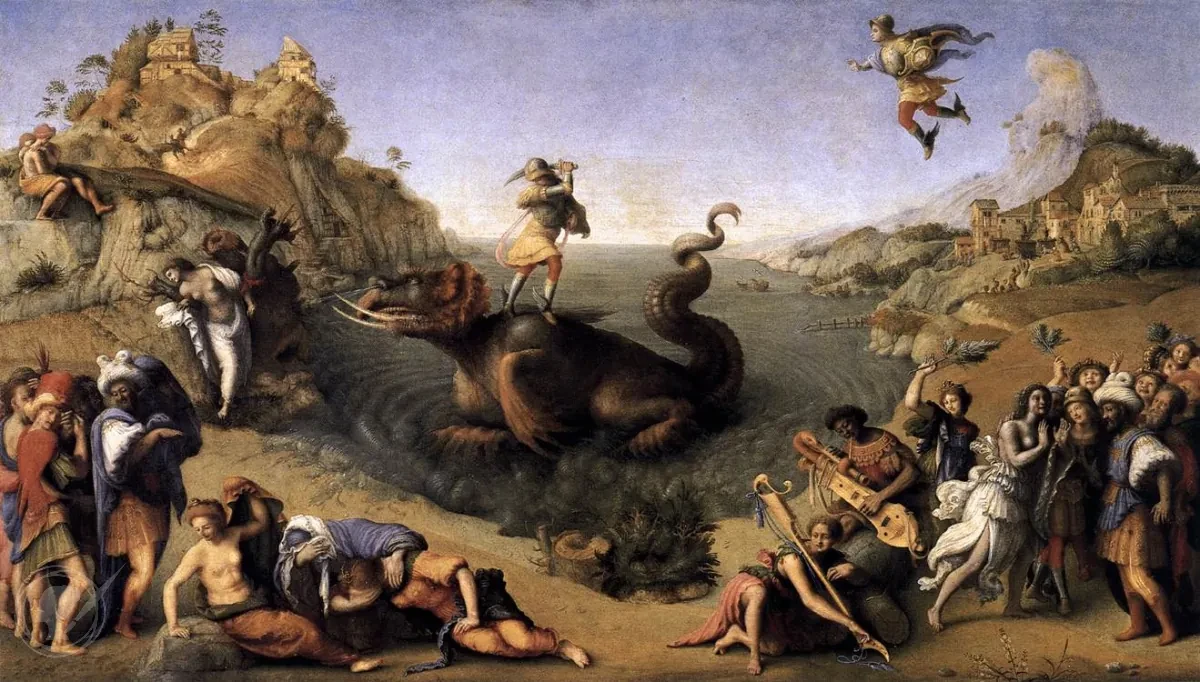
The very first poem, ‘The Andromeda Paradox,’ offers us an image of this conflict: Andromeda is chained to the rocks when Perseus, flying by, catches sight of her:
Did she see a prince, did he see a wife
The first time we met
I was sitting, and you walked in the door
In physics, the Andromeda Paradox posits that two observers in different states of motion (and everything is in motion) might state an event to have happened and not happened at the same time. In the poem, the Ethiopian princess, Andromeda, who is chained to the rocks, watches the warrior Perseus flying by on his winged sandals, and sees him as her liberator; while Perseus, blessed by the gods, returning home after slaying the monster Medusa, sees the beautiful Andromeda as his prize. The paradox stands true in both science and art: both propositions are true at the same time, and yet, we know, as beings of flesh and bones, the two can’t survive the test of our finite reality.
Do we ever overcome the fissures that mark the beginning of our relationships? For Malik, this question of relationships — what he sees, what she seeks — is not mere difference in perspective. It is the thing itself.
And so begins the pounding of the ideals of romantic love in the mortar and pestle of domestic life. The very next poem, ‘After Juliet,’ stages the drama of the sublime Juliet getting crushed daily in “the gaping maw” of the washing machine:
it said ‘companionship’ on the brochure
it said laughs and films and happy little babies
then why am i defrosting a deep-freezer, why
are the children fighting
why are you wiping chocolate on my thousand
thread count sheets
(always the fucking laundry
it all comes down to
the
gaping
maw
of the washer)
The crack that opened with Andromeda and Perseus now shows itself: what was advertised (nurturing companionship, happy babies) versus how it is (fucking toilets that won’t flush). It is a measure of Malik’s dexterity that she can hold Shakespeare’s heroine at her full weight — she remains a tragic reference when viewed against the collection as a whole — while also invoking her ironically — pathetic and alone, an everywoman, everywhere.
Some of the most memorable poems in the book chronicle the thankless meticulousness of domestic life; the daily labor of love that feels more and more like a daily ritual of self-trituration, which leaves behind the fine powder of regret. The formal centerpiece of this mode is ‘Inventory,’ printed in landscape across the page so that it reads like a list.
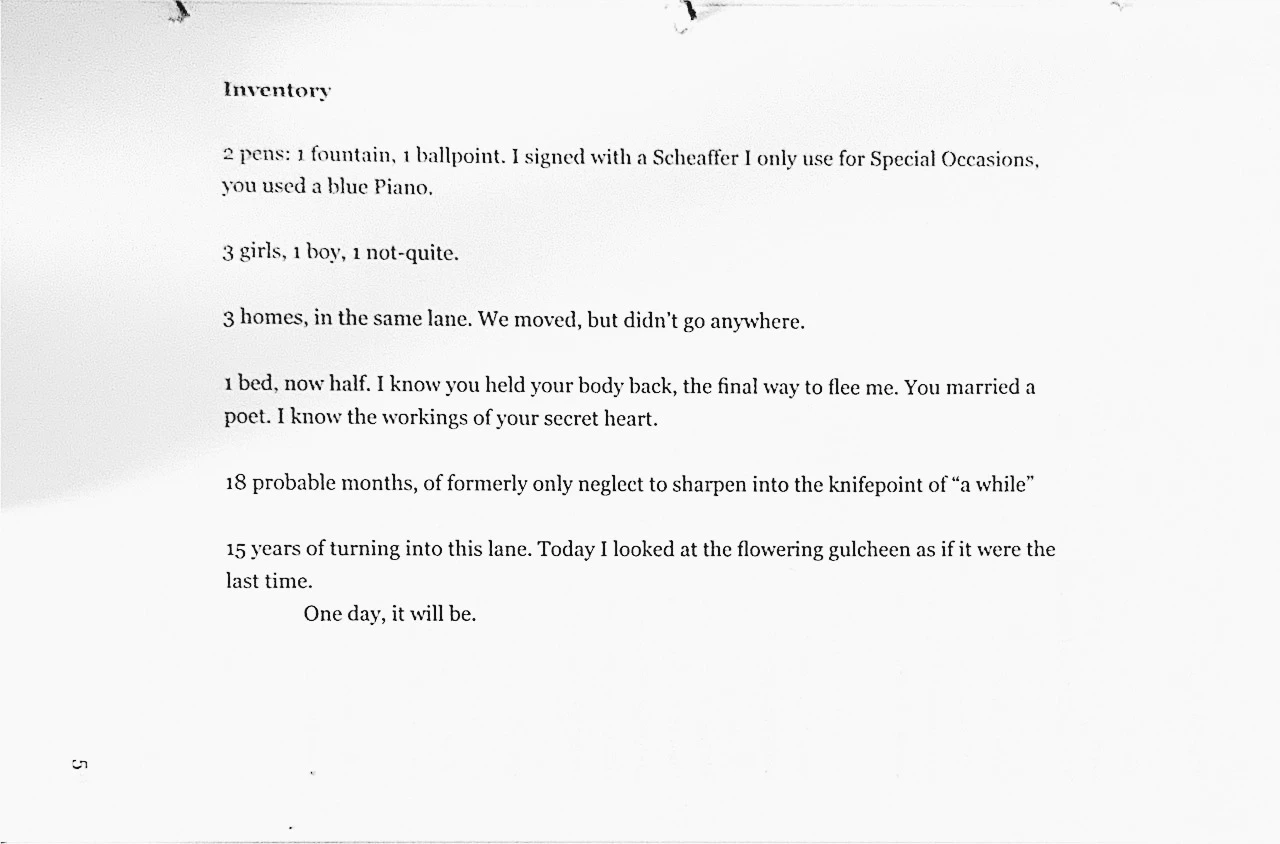
An inventory accounts for what you are left with after the business is done, but the poem is also an elaboration. The notes are brief, one realizes, perhaps not out of restraint, but out of the realization that this was all. That this is all there ever was.
From here, the collection pivots into a chronicle of an aftermath. What is asked of a woman, in private and public. The diptych poem, ‘sabr, shukar’ traces patience and gratitude through how they are deployed as advice, as an antidote to suffering—to not see how things were; to not speak what was; to see something worse instead; say something sweet to not taste the bitterness in one’s mouth.
It is worth pausing over the collection’s cast of characters: Andromeda, Cetus, Perseus, Juliet, a goblin guarding a dragon-hoard, doppelgänger, Circe, Galileo, an astronaut. And of course, you realize, it makes sense. The world is too much to bear without imagination.
shukar : “it could be worse”.
the clang of gratitude
turns the air electric with suspicion.
worse than? the list is predictable,
the list is wearily known:
beating
cheating
stealing
raping
lock you in the house even though your father is dying
watch you bleed out his baby but lock you in the house
beating
acid
too-tight wrist grabs
no money
and so forth. be thankful. shukar
What began as a split in perspective with the first poem, deepens into a gulf, then a darkening gulch, as the collection proceeds—and what began as an Andromedan desire to be rescued, travels through regret, resentment, and grief, and morphs into anger, which grants the narrator the power to see clearly—not how she desired the world to be, but how the world truly is: full of swine, undeserving of her pearls.
sometimes it is quite accurate to reckon that your gifts
are cast before swine. most of the time, this is true.
sometimes it is fine to wish for
untamed powers: turn them all to pigs,
keep your pearls.
As the narrator transforms into Circe, the Homeric witch who turns men to swine, it is worth pausing over the collection’s cast of characters: Andromeda, Cetus, Perseus, Juliet, a goblin guarding a dragon-hoard, doppelgänger, Circe, Galileo, an astronaut. And of course, you realize, it makes sense. The world is too much to bear without imagination, and much of this book is a reckoning—and an exercise in learning not to look away.
Galileo
Well, shit, Galileo thought,
smoothing a hand over his beard,
to himself (look where external
thoughts got him)
Of course the sun was trouble. He
should have known. But what does
one do, earthbound with knowledge,
watching the apples fall, stars move,
the moon breathe? No, he thought,
locked in with his books and the
ticking clock of his mind. No,
the gravity of the situation
was clear. Once you've seen the sun
you can't look away, once you eat
the apple what can the Pope do,
your father do,
the witness of your eyes do,
except speak?
This is the ars poetica—the need to speak once you have seen the sun, which is invariably accompanied by the dread of the knowledge that the sun is trouble for earthbound creatures. But what can you do except speak? What can you do but go rogue?
The collection ends with how it opens: with movement, in space. ‘Astronaut is puzzled’ describes the faltering communication between an Astronaut and his lost Satellite. The Astronaut had planned everything like a mathematical equation, plotted every eventuality like a geometrical chart, but finds himself puzzled because the Satellite has catapulted into the stratosphere without permission or information. She has revealed herself to be not what he imagined, but a cartoon sidekick, a moon-calf, who laughs and doesn’t respond to the Astronaut’s calls any longer. The Astronaut calls, but doesn’t get a reply. Sometimes, he catches a signal where she’s laughing on the radio. The Astronaut doesn’t know what it means.
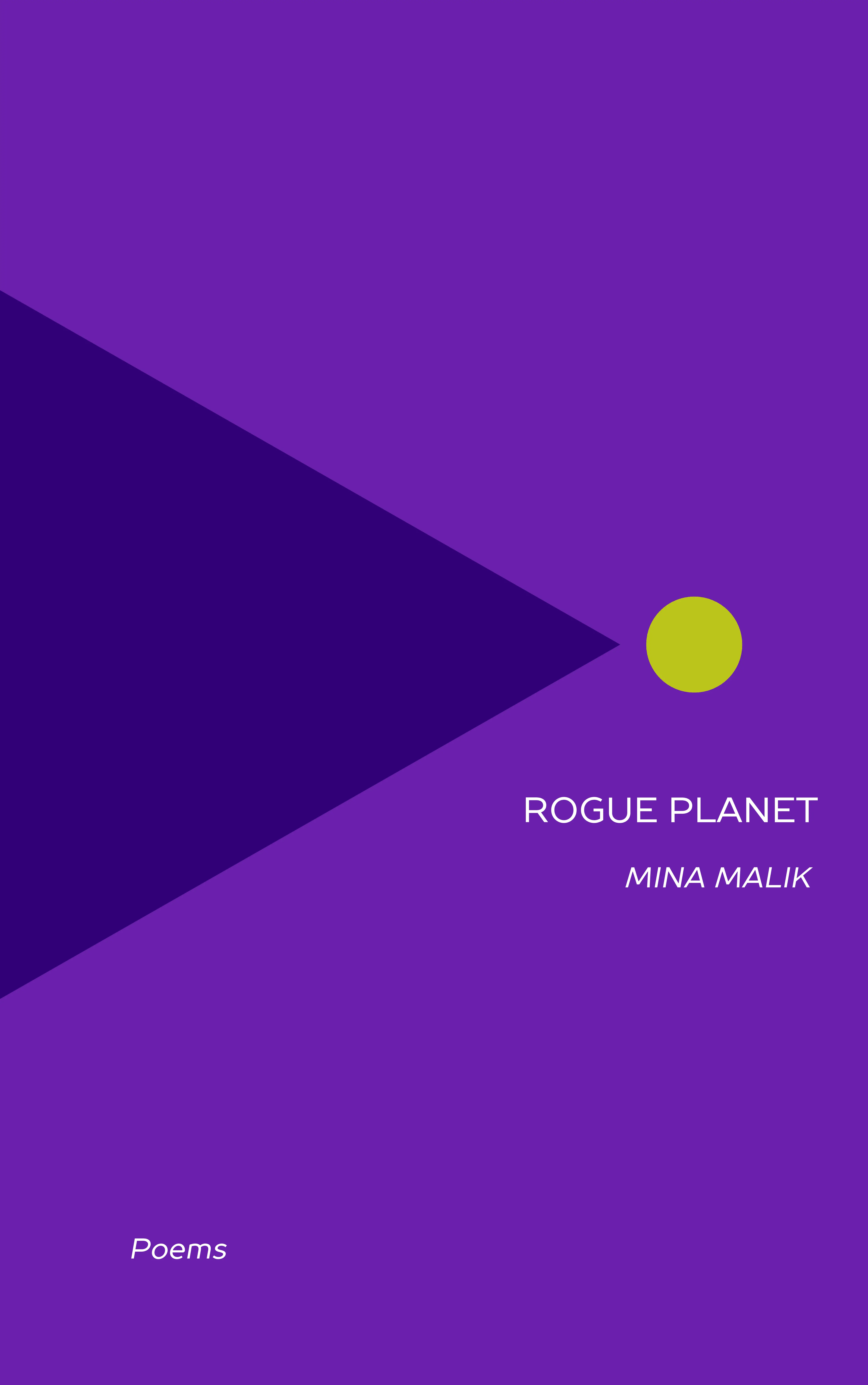
The slim book has a purple color cover with a yellow circle at the horizontal point of a dark triangle, both of which are mirrored on the back cover, except the planet at the back is an embossed outline—as if to say what began as a yellow planet at the beginning of the book has ejected—exactly like a rogue planet, which famously does not orbit a star, nor emit any light.
There are billions of them in the Milky Way, but they are notoriously hard to identify.

Bilal Tanweer is a writer and translator. He is the author of the novel The Scatter Here Is Too Great and the children’s book The Boy Who Thought He Was A Car. His translations include Muhammad Khalid Akhtar's Love in Chakiwara and Other Misadventures, Sa’adat Hasan Manto, Sarmad Sehbai, and Ibn-e Safi. He was the Chair of Jury for the 2023 Commonwealth Short Story Prize. He teaches at LUMS, Lahore.