
In July of this year, PM Shehbaz Sharif constituted a ‘National Population Council’ with a mandate to tackle Pakistan’s high rates of population growth. The numerical target aims for annual population growth to decline from 2.55% to 1.35% per year by 2035. Given that growth rates have only slowed down slightly during past intercensal periods – 2.87% between 1972-1981 and 2.55% between 2017-2023 - halving them in the next decade will require drastically rectifying past failures in population management.
Pakistan’s official position on its demographic future sits at odds with current global discourse around population growth and fertility. Much of the rest of the world is experiencing a steep fall in total fertility rates and a rapid rise in the share of an aging population. Recent estimates by economist Jesus Fernandez-Villaverde show that the fertility rate for the world as a whole dropped below the replacement rate of 2.2 live births per woman in 2023 likely for the first time in human history.
What’s more remarkable about this demographic shift is that it cuts across country wealth levels and even broad cultural differences. The data tells us this isn't a rich-country or "Western decadence" story. A pioneer of the population management approach, China, has seen 2025 births falling to 7.92 million with a total fertility rate of 0.93. Colombia's fertility rate at 1.06, Iran's at 1.44, Turkey's at 1.48 are also all below the US. Within country drops are at times even more stark, with Mexico City down to 0.95, lower than Tokyo's 0.99.
On the cultural front, Muslim-majority countries like Tunisia (1.56), Turkey (1.48), and Iran (1.44), or Catholic contexts like Colombia (1.06) and Mexico (1.6) have similar or even lower rates compared to secular or broadly Protestant societies, undercutting the assumption that religiosity protects fertility.
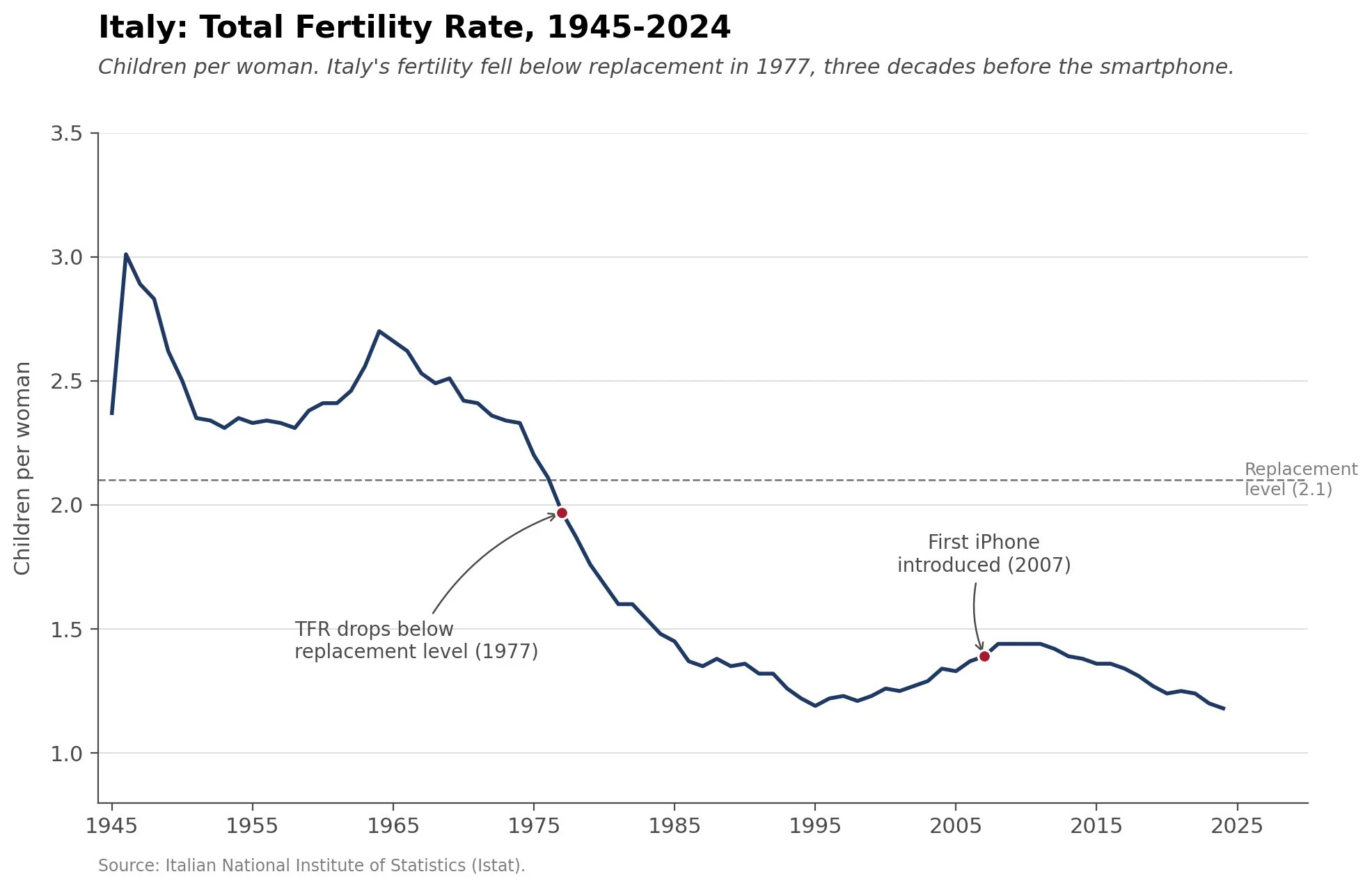
Attempts at explaining a decline in fertility have to account for this massive cross-sectional transformation. Stories that focus exclusively on levels of societal wealth or broad cultural factors cannot explain the trend replicating itself in contexts as varied as Norway and India. A recent, somewhat controversial attempt at a unified theory looked to smartphones as the answer, suggesting that screentime proliferation across the world reduces coupling and increases social isolation, both of which undermine fertility.
It is clear that unlike in China or Iran, state policy has had very little impact on population growth. Targets set in the past have routinely been missed, and only sub-Saharan African states and a few other outliers have seen slower drops in fertility rates than Pakistan.
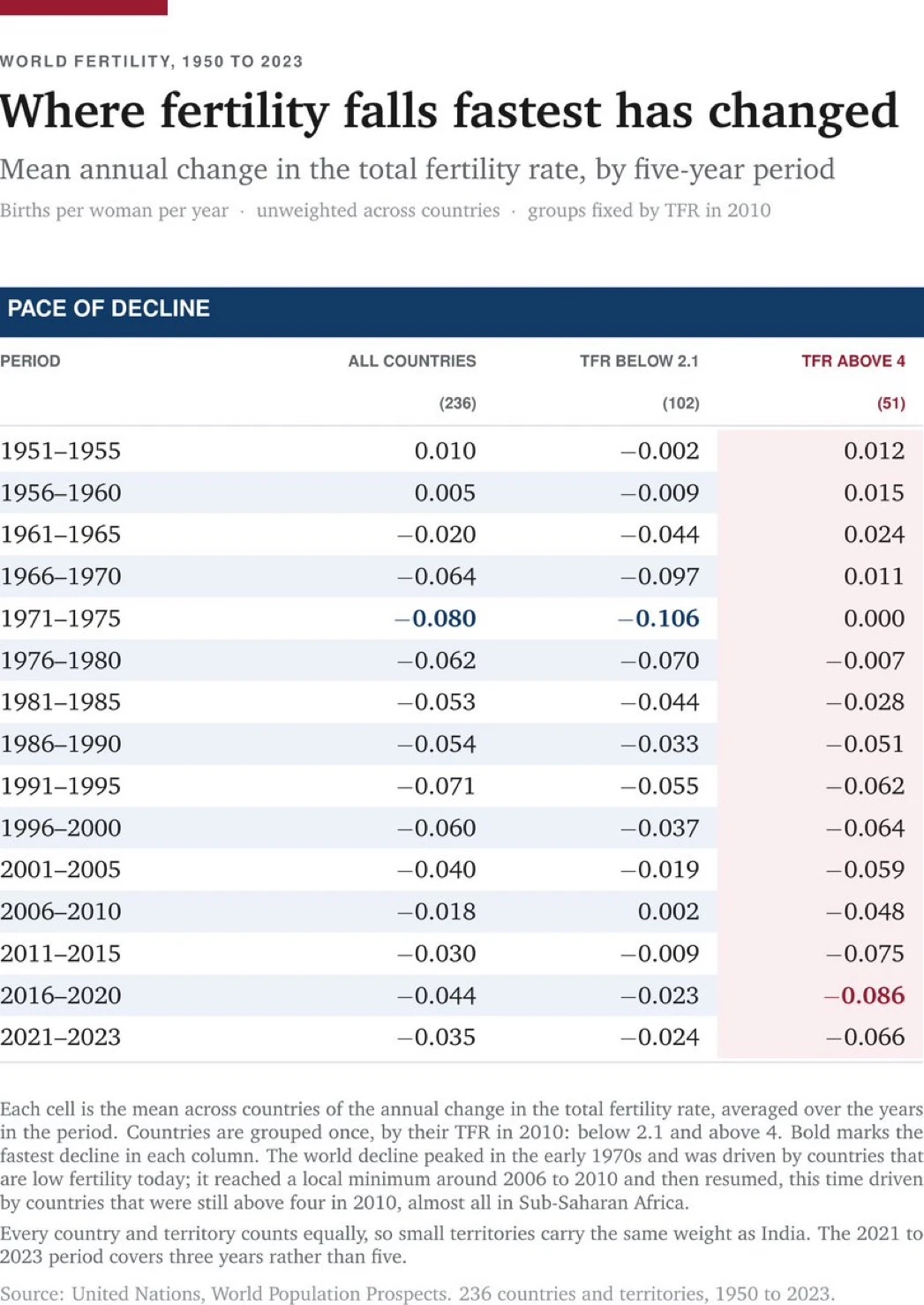
While there is some truth to the social isolation story (marriage rates have been falling the world over too), the broader trend is that fertility has been in decline since the late 19th century. This demographic shift is a story of modernity and modernization, but refracted and increasingly accelerated through improved access to infant mortality-related healthcare, rapid urbanization and higher costs of living, and increased female labour force participation.
Pakistan is not immune to this onward march of modernity. The fertility rate has roughly halved over the past 4 decades, falling from 6.71 in 1990 to 3.4 today. While population growth still remains high on account of increased lifespans, and because higher fertility rates in previous generations are experienced over multiple decades, this rate will likely taper off in the years to come.
This leads to an interesting, albeit underexplored, debate on what the contours of a population policy should look like in Pakistan. It is clear that unlike in China or Iran, state policy has had very little impact on population growth. Targets set in the past have routinely been missed, and only sub-Saharan African states and a few other outliers have seen slower drops in fertility rates than Pakistan.
As the rest of the world deals with the ‘economics of a shrinking world’ and struggles with the near-future question of sustaining an economy with an aging population and a reduced labour force, Pakistani policymakers and commentators are perennially thinking about the opposite question: how do we shrink the population, especially among impoverished households, to make do with a struggling economy?
This seems like a misplaced fixation for two distinct reasons. Firstly, in any organized society, labour creates value. It is the nerves, sinews, and muscles of living, breathing people that make an economy. Put crudely, having fewer people means fewer producers, which means a ceiling on total economic output. This is what currently animates the natalist conversation on both the right and even parts of the left of the political spectrum in many other parts of the world.
But equally relevant is the second reason: If scarcity is the default condition (which it doesn’t have to be if labour is deployed productively), the question of redistribution becomes all the more important. There are enough resources to feed, house, and clothe a large population, provided they are distributed in a more egalitarian way. This part is routinely missed out.
Women entering the labor force was certainly integral for economic growth, but it also freed many from the drudgery of housework, the coercion of biological reproduction, and the violence of the patriarchal household.
Leaving these two aside, then, perhaps the only substantive reason to focus on population growth and fertility in a country like Pakistan is because of its implication for gender norms and gender equality in the country.
The story of modernity is also at its core a story of cultural shifts and transformations in how men and women interact with each other. It is a story of women achieving hard fought gains in political participation, economic freedom, and cultural autonomy. Women entering the labor force was certainly integral for economic growth, but it also freed many from the drudgery of housework, the coercion of biological reproduction, and the violence of the patriarchal household.
Any conversation about population and population policy, then, is ultimately a conversation about gender rights. Its animating logic should not be scarcity of economic resources or the supposed animal instincts of the impoverished which require forceful curtailment, but rather a concern with the underlying cultural norms and institutional conditions that limit autonomy of decision-making for women on key issues of marriage and reproduction. If the needle moves on that front, the population ‘problem’, as it is currently framed, will resolve itself automatically.

Umair Javed teaches sociology at LUMS. Twitter: @umairjav