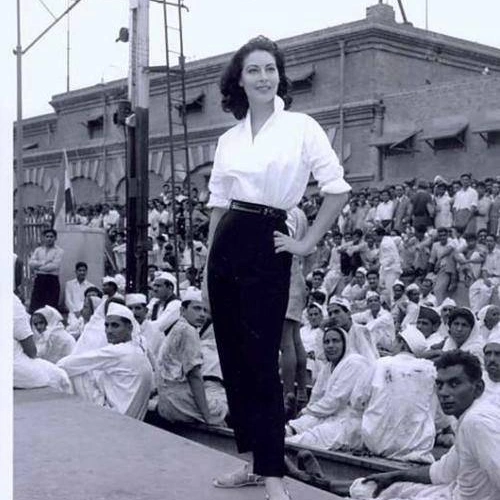
On May 1st, Bhowani Junction (1956) — starring Ava Gardner and Stewart Granger, directed by George Cukor — marked seventy years of its release. French filmmaker and critic Jean Luc Godard included this American-British runaway production in the top ten films of 1956. Largely forgotten in Hollywood, this film holds a specific significance in Pakistani film and cultural history. For instance, it has an impactful presence in Mustansir Hussain Tarar’s novel Raakh (2015) — characters spot Gardner and Granger on Lahore’s Mall Road and obtain autographs, in fact a whole chapter is dedicated to the production of the film; in industrialist M.P. Bhandara’s collection of essays, Calling a Spade a Spade (2010), the film is recounted as a moment that shook up Lahore from its slumber. Bhandara then recalls a comical incident when sheer happenstance led him to escort Gardner to the lavatory. Film historian Kate Fortmueller’s essay “Encounters at the Margins of Hollywood: Casting and Location Shooting for Bhowani Junction” is entirely dedicated to the exploration of this unique production. She states that people in Pakistan have used this film to identify their family and relatives who played extras in the film, adding another layer to its already existing textual complexities.
The film brought Gardner, Granger and Cukor with his crew, job opportunities, spectacle, and allegedly a modern railway station sound system to the newly independent, lyrically slow life of Lahore. The cast stayed at the Faletti’s Hotel, where the Ava Gardner Suite, featuring archives from the film, still exists today as a witness to the golden times. During two months of on-location shoots, thousands of locals (at times, entire neighbourhoods) got to be part of this extravaganza by playing background actors. The unseen thousands followed the crew. A handful of Pakistani artists, including actor Neelo and filmmaker Qadeer Ghauri, got their first opportunity with this film. Neelo, who played a small role as a journalist, went on to become a major celebrity in Pakistani cinema, and Qadeer Ghauri, an assistant director, later made the musical Mousiqar (1962) starring Santosh Kumar and Sabiha Khanum. Beneath this benign and well-known legacy of opportunities and enchantment, though, exists a web of erasures that reflects the exploitation of Hollywood.
During two months of on-location shoots, thousands of locals (at times, entire neighbourhoods) got to be part of this extravaganza by playing background actors. The unseen thousands followed the crew.
Sailing on imperial vessels, Metro-Goldwyn-Mayer, or MGM, sought to benefit from Britain’s overseas influence, get cheap labour and evade taxes back home. Initially supposed to be shot in India, the production unit found its transitory home in Lahore. Bhowani Junction, an adaptation of British novelist John Masters’s 1952 novel, is set in an eponymous fictional town in turbulent India during the last days of British colonialism. The colonised Subcontinent, as always, is wounded by conflicting forces of nationalist parties, communists and colonialists, resulting in mayhem and chaos.
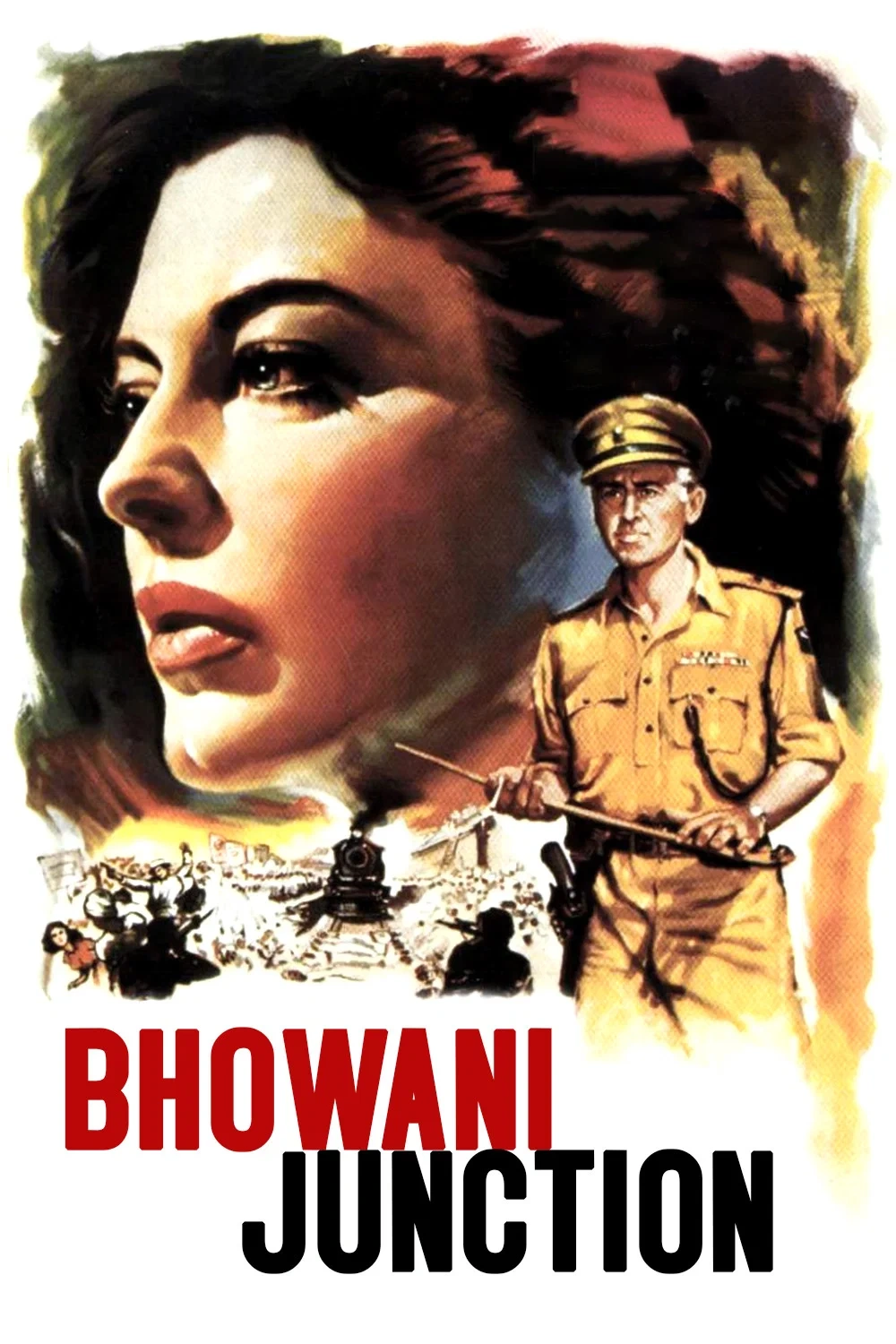
Ava Gardner plays Victoria Jones, an Anglo-Indian who belongs nowhere because of her ‘impure’ origins. She is an “Indian with English blood or English with Indian,” says Colonel Savage, portrayed by Granger. This antimetabole makes her existence a confusion or a paradox. Everything about her life is unoriginal and deviant, lacking ground. For instance, Victoria calls her Anglo-Indian parents ‘pater’ and ‘mater’, rather than the common father and mother. She and other Anglo-Indians feel conflicted about which side to support, exhibiting volatility. They lack history, evoke disgust and become an inconvenience to both the colonised and the colonisers. Interestingly, and ironically, the film, while being Victoria’s story, is narrated by Colonel Savage, and largely remains under the men’s desires, despite its female protagonist.
Victoria finds her sense of belonging through her love affairs with Anglo-Indian Patrick Taylor (Bill Travers), Indian Sikh Ranjit Kasel (Francis Matthews) and eventually settles for the British Colonel Savage. In terms of anxiety of choice, the restrictions from the Hays Code (1934-1968) also aided in settling for a white British character. The code forbade on-screen romance between people of different races. Despite being set during the pre-independence political unrest, the film maintains its melodramatic tone and pushes the unrest into the background.
The emphasis on the love stories might have been the motivation for studios to hire George Cukor. He was known as a women’s filmmaker throughout his career. However, he had never worked outside of America and undertook a train journey to understand the feel of real India for this film. In popular culture, he is also credited with popularising the word ‘gaslight’ to mean the psychological manipulation of one’s reality, owing to his 1944 film, Gaslight, a remake of the 1938 British film of the same name. On an often-ignored front, he was also infamous as a director for psychologically tormenting his actresses to get the required performances. Carmen Maria Machado wrote about Cukor’s problematic creative process in her memoir In the Dream House (Graywolf Press, 2019).
Bhowani Junction was built upon similar violence on race, but its manifestations were both on-screen and off-screen. The film erased both local faces and spaces, reshaping and renaming them to meet the narrative’s needs, mirroring settler colonialism. During the film’s production, Lahore’s colonial-era railway station was turned into Bhowani Junction. Several spaces of Lahore had not yet recovered from “the hauntings of colonial violence.” Postcolonial scholar Ghirmai Negash explains this hauntology in his essay “Hauntings of Colonial Violence: Views from 1927 and 2020 Eritrea” from Spazio Disponibile (Mousse Publishing, 2022). Lahore’s spaces took on the visuals of the pre-partition menace and re-enacted the violence. Tarar, in his novel, pointed out an irony that people in Lahore wore Nehruvian caps for their roles in the film to make extra bucks, even though Nehru was not liked in Pakistan. Ava Gardner, a white American, played a mixed Anglo-Indian. British actor Francis Matthews played Ranjit Kasel through brown-facing, a common racist practice in Hollywood. Peter Illing, an Austrian-British actor, played Davay, the local communist threat to both local parties and the British. He is hunchbacked in the role, like a monster, and operates covertly in the darkness of tunnels and nights. In a supporting role, Marne Maitland, an Anglo-Indian, was the only Indian origin actor who played a relatively major role as the local collector. However, he is also referred to as ‘wog’, a highly offensive term for Indians.
This lack of authentic representation raises several concerns about Hollywood’s deliberate erasure. For example, Lahore had a flourishing film industry in the 1950s, involved in the project of identity formation of the new nation. A small Anglo-Indian community thrived in the heart of the city till the 1970s. In her essay, Fortmueller wrote that Cukor received letters and portfolios from several local actors for the leading roles, but they were not considered. The film, being a runaway co-production, had to include both British and American actors as per the norm. This casting practice reflected a deep structural exclusion and caused subsequent erasures in the country of production.
Despite restrictions for the major roles, the film banked on cheap labour for smaller roles. Several scenes of the film were choked with extras, who added to the wide-frame spectacle and constituted a stereotypical poor Indian life. At one point at the railway station, the character Patrick Taylor physically picks up a local man and throws him away to make way for himself. The locals are merely props and bare bodies lacking any agency or voice. Most of the time, the background voices of the local languages, when mixed, don’t make for a recognisable chorus, but sound like gibberish with uneven intonations. Overall, the locals, as bell hooks in her book Black Looks: Race and Representation (South End Pr, 1992) says, serve “to highlight the whiteness” or “enhance the blank landscape of whiteness.” Anything apart from the whiteness in the film is gibberish, uninteresting and even threatening.
Bhowani Junction was built upon similar violence on race, but its manifestations were both on-screen and off-screen. The film erased both local faces and spaces, reshaping and renaming them to meet the narrative’s needs, mirroring settler colonialism.
Through various accounts we know that the cast and crew of Bhowani Junction found their experience of shooting in Lahore challenging. Despite these and other difficulties, though, the film got completed, garnered praise for its panoramic sequences and earned good profits. For the production unit, it was a dangerous yet exotic adventure, a step forward in Hollywood's globalisation and a way to save money in the land of the previously colonised.
During the process, however, it reinforced colonial relationships through racial and spatial erasures, erasures and uneven relationships that are still rampant in western film’s approach towards the east. Seventy years on, with the film and its stars’ presence in Lahore still appearing in nostalgic social media posts, it is even more urgent to consider the way its legacy is built on the backs of exploitative and racist practices that live on in the global film industry.
Aqeel Ahmad is a writer and student of film and postcolonial literatures. He is a recipient of the Dr. Joseph Bunn Heidler Memorial Fund. His creative work and criticism have been published in North Dakota Quarterly (Vol. 1), Brooklyn Magazine, Studies in South Asian Film & Media and DAWN Images.