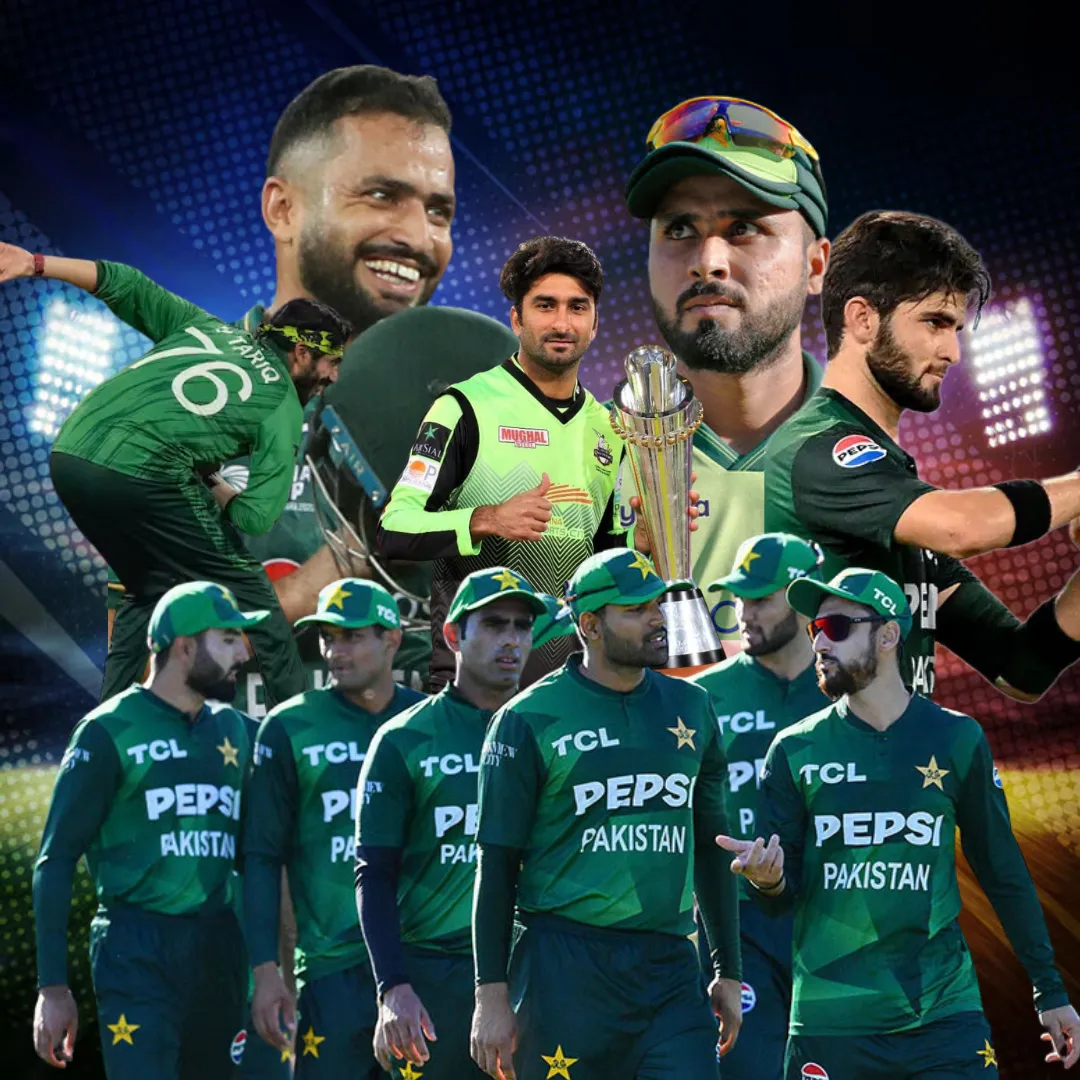
In the modern cricketing world, where each decision from toss to field settings and bowling options is driven by data analytics, Pakistan continues to be an enigma. As a team that brings a fresh air of unpredictability and volatility with it, it gets hard to predict which version of the Pakistan team will show up on a given day (no one would have expected Pakistan to come dangerously close to losing to the Netherlands just a week after they demolished Australia 3-0 in Lahore).
With two wins out of two, the Pakistan cricket team seems to be on a high at the ICC Men’s T20 World Cup this year. Barring any upsets (which is a dangerous assumption to make for Pakistan), the team is virtually in the Super Eights. An idealistic fan can dream of the team going even beyond the Super Eights, due to the potency of the Pakistani spin attack coupled with the vulnerability some of the other teams have exhibited against spin. Those who have been watching the Pakistan team in this World Cup, however, know that this is far from the reality. Unless some serious data-driven decisions are taken, the flight back to Lahore could be sooner than later. The question is, is the team management brave enough to make some tough calls?
Going into the World Cup, there were lots of questions. Would Salman Ali Agha be this consistent at number 3 against other teams? Would a middle order consisting of Shadab and Nawaz work against ‘better’ teams? Does playing Babar at 4 make sense? Simply put, this new combination had not been tested enough.
This moment in the spotlight is rare for fans and players alike. It is in such moments where decision making can be clouded. The external noise surrounding the India-Pakistan clash is always high. This time around, marred by the handshake controversy and the political build-up, the pressure is significantly higher.
In the tournament opener versus the Netherlands, Faheem Ashraf’s heroics seldom put any concerns to rest, as many were left wondering about the gaping flaws that the Dutchmen exposed. One could only wonder what would be in store against the USA. Many were anticipating another upset; this would have virtually knocked Pakistan out from this year’s tournament within a span of 4 days. What followed was a statement win against the USA, which has since re-ignited the World Cup fervour.
Furthermore, the paranoia in the Indian media regarding Usman Tariq’s action has been interpreted as a sign that there is an environment of anxiety amongst the Indian fans — that the Boogeyman is coming for India next. Outside the field, the constant chatter about the backdoor politics it took Pakistan to reverse its stance on playing India has, likewise, been seen as a statement about the power that Pakistan’s cricket team holds at the moment.
There is a feeling that Pakistan cannot be ignored at this World Cup — be it the players, or Pakistan's importance in the global cricketing community. This moment in the spotlight is rare for fans and players alike.
It is in such moments where decision making can be clouded. The external noise surrounding the India-Pakistan clash is always high. This time around, marred by the handshake controversy and the political build-up, the pressure is significantly higher.
Pressure can be a great motivator, though; the Cornered Tigers of 1992 proved that. However, at the same time, if not handled appropriately, pressure can lead to erroneous decision making too. It is not too illogical to assume that there would be a lot of inertia towards making any changes to the team. After all, this combination has won two games, and in case the team loses to India, all eyes will turn towards the team changes made.
The management has to shut out all the noise, and in a very un-Pakistan-like way, evaluate data for what it is, rather than embracing the moment and going with gut feelings. A cricket-crazy nation brings with it an obsessive fan following of certain superstars. The aim should be to rise above all this and send out a clear message that no one is bigger than the team. Some changes may sound audacious, but make sense, the end goal should be to follow what seems rational.
To illustrate the point above, we can compare Shaheen Afridi and Salman Mirza. Past performances suggest that starting Salman Mirza ahead of Shaheen Afridi could be a logical change. Shaheen's record against India has not been impressive as of late and the contrast between the two left arm quicks was stark in the tournament opener with the Netherlands.
However, Shaheen can whack a few with the bat, and has a certain reputation for his opening spells. Just like Kohli shut down a question back in 2021 regarding an out-of-form Rohit Sharma by asking rhetorically “Would you drop Rohit Sharma?”— the same can be said here. The trade-off is steep: experience and reputation versus cold, hard data.
Another audacious move could be to drop Mohammad Nawaz. He had a prolific 2025, but his less than impressive record against left-arm batsmen, paired with the abundance of left arm batsmen in the Indian lineup makes him a bowling liability. His batting performances have been less than impressive of late as well. To replace him with an inexperienced Khawaja Nafey would make sense, as we already have enough spinners, and Nafey would give a lot more security in the batting lineup. However, identical to the Shaheen versus Salman dilemma, one cannot help but think if it's wise to drop a seasoned player for someone who would be playing just for the third time for Pakistan in such an important game.
The management has to shut out all the noise, and in a very un-Pakistan-like way, evaluate data for what it is, rather than embracing the moment and going with gut feelings. A cricket-crazy nation brings with it an obsessive fan following of certain superstars. The aim should be to rise above all this and send out a clear message that no one is bigger than the team. Some changes may sound audacious, but make sense, the end goal should be to follow what seems rational.
Pakistan could just drop Faheem for a proper batsman as well if they are not planning to utilise his bowling. Without his bowling he is virtually playing as a batsman, and so would it not make sense to play someone else with better statistics? The question then comes up, are we brave enough to drop someone who can win the odd game for someone who, on paper, will probably provide greater safety with the bat?
The debate regarding who should or should not play will not end. Any decision taken will be in the news regardless. A loss against India will call out the shambolic decision making, and a win will hail the management as a group of masterminds.
There are trade-offs and opportunity costs everywhere, however, what matters at the end of the day is how we can justify ourselves. It is easier to explain the decision making process when we can share the numbers that are driving the chain of thought. This allows us to see the decision at its face value, and understand the thought process, allowing for a critical evaluation. A decision made on gut feeling and ‘experience’ only narrows down the approach; it does not enable one to effectively troubleshoot once things start going south.
Pakistan has been in the spotlight in the World Cup till now, be it the Indian media launching an attack against Usman Tariq, or the political controversies around India and Pakistan playing. This inevitably brings with it an added layer of pressure. To do well against India, or generally in the World Cup, the management needs to rise above the noise and go for a braver approach — one that in a very un-Pakistan-like way, chooses to prioritise data over gut feelings and popular perceptions, and looks beyond names.

Moiz Asim is a cricket enthusiast and a 2024 graduate of the Lahore University of Management Sciences (LUMS) with a degree in Management Sciences. He has previously written for The Nation and served as a Teaching Assistant for the only undergraduate Sports Management course offered at LUMS. His interests lie in examining the socio-economic and political implications of sport in the contemporary global economy.