
I was sitting at the Polo Ground at Islamabad Club recently, when a friend, Turab, pointed out Shoaib Akhtar, who was making his way around the running track.
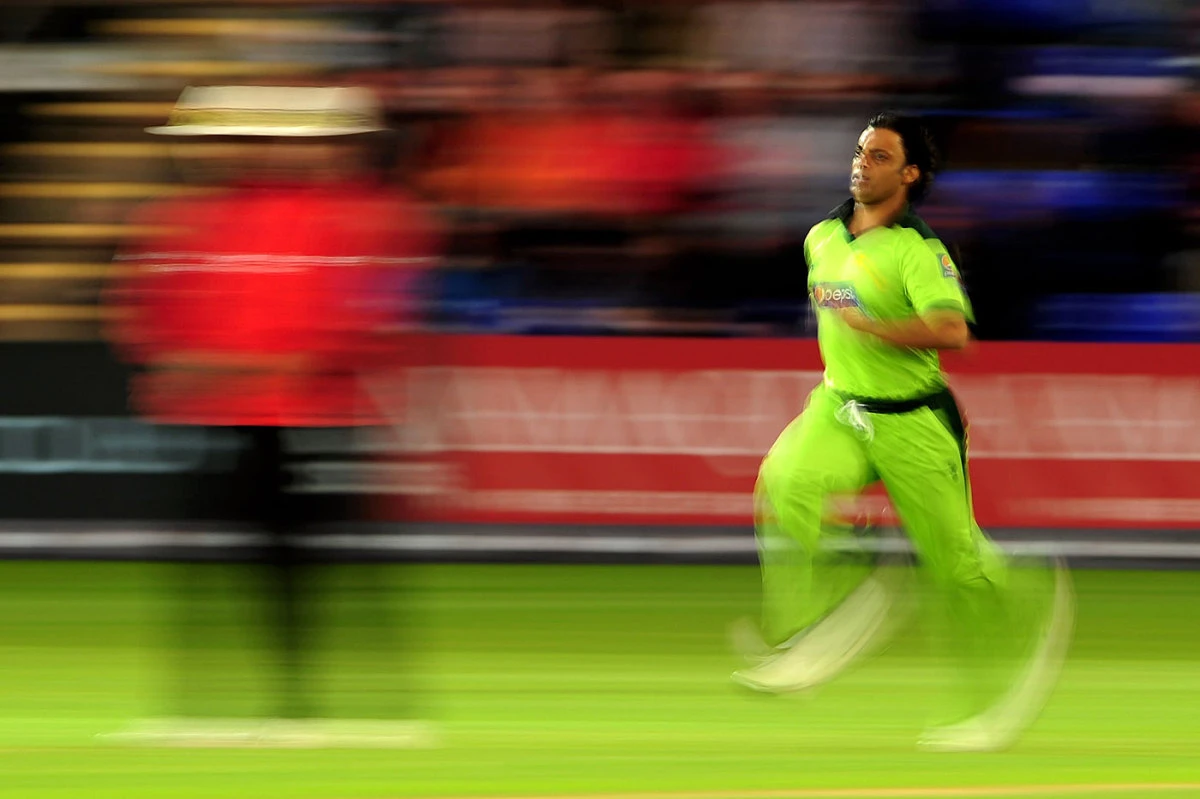
Calling it a run would be generous. He was moving at a pace slower than most people walk at. Yet, even from a distance, it was unmistakably Shoaib Akhtar. Not because you could see his face, but because this was his run-up and his alone. His elbows were up, shoulders leaned forward, every stride looked like it was taken in anger. Even at what was essentially a jogging pace, his body refused to abandon the language it had spoken all his life. It looked like he was just about to bowl at 90+ miles an hour, a ball that would lead to stumps cartwheeling or toes getting broken.
A few days later, while I was working on PTV Sports’ FIFA World Cup transmission, I shared the screen for the first time with Shoaib Akhtar and again there was something very Shaibi about Shaibi. This inevitably led me down another one of my YouTube rabbit holes. One Shoaib Akhtar spell became a highlights package, highlights became interviews of batters who had faced him, eventually the interviews became grainy footage from Sharjah and Kolkata.
Somewhere in the middle of it all I wanted to start listening to Iron Maiden. I had not listened to proper heavy metal in years. But it made perfect sense — after all, Shoaib Akhtar is heavy metal and not metaphorically, but literally.
He bowled like the ball had personally offended him. There was always a sense that he wasn’t merely aiming for wickets, he wanted to overwhelm, scare, intimidate and eventually destroy his opponents.
If cricketers were music genres, most great players would belong somewhere else. Wasim Akram would probably be a symphony; Brian Lara would be jazz; Shane Warne the beats of classical rock. Shoaib was never any of those things, there was nothing classical about him. He was Iron Maiden’s Fear of the Dark, he was Metallica’s Unforgiven.
Shoaib Akhtar’s bowling wasn’t trying to soothe you, it wanted to shake something loose inside you. That’s the strange and beautiful thing about watching him bowl. Watching his YouTube videos didn’t simply entertain me, it changed my mood. His bowling made me feel younger, it made me feel angrier, it made me want to rebel against something that probably wasn’t even worth rebelling against.
Watching him bowl makes me remember what it felt like to be sixteen. The age where every inconvenience feels like oppression, every disagreement an injustice; it feels like every authority figure is conspiring to stop you from becoming who you are meant to be. Most of us grow out of that feeling — watching Shoaib somehow brings it back. Very few athletes can stir up so many emotions inside you the way Shoaib Akhtar can.
Because Shoaib wasn’t simply fast, because pace is measurable by speed guns; what Shaibi-the-bowler was is immeasurable. He was violence, not cruelty, but a sheer violent force. The kind that exists in music and cinema, the kind that exists inside all of us. Everyone carries frustration and disappointment, and we have all experienced conversations we wish had gone differently. Everyone has had days where we wanted to scream but couldn’t. Shoaib Akhtar personified the scream we could never let out.
His bowling was the release of pent-up emotions inside the spectators. Every stride in that extremely long run-up were those emotions gathering momentum. That was why his wickets felt so different. Not because another batter had been dismissed, but because of how they were dismissed. I can still see those yorkers to Rahul Dravid and Sachin Tendulkar: the ball doesn’t merely hit the stumps, it detonates them. The leg stump performs a cartwheel, the middle stump leaves the ground. Bails disappear into another orbit that cameras struggle to follow.
As a fan, you almost celebrate the stumps flying more than the wicket. It sounds ridiculous until you have experienced it. When Shoaib uprooted stumps, it was your bottled scream taking form. It wasn’t just a wicket, it was catharsis.
Nobody listens to Iron Maiden because they want to relax, they listen to them to feel something different. People’s music taste is subjective and often not explicable. For instance, I can’t fully explain what heavy metal meant to me growing up, but I listened to it because that noise inevitably became therapy, chaos became order. That is what Shoaib Akhtar meant to so many, including myself.
He bowled like the ball had personally offended him. There was always a sense that he wasn’t merely aiming for wickets, he wanted to overwhelm, scare, intimidate and eventually destroy his opponents.
I have watched countless fast bowlers and I can argue many were greater than him. Some were more complete, many achieved way more, and most had better control, better fitness and better careers. But none made me feel what Shoaib made me feel.
It’s because Shoaib Akhtar’s bowling was never really about cricket. It was a performance. His run-up alone deserved its own soundtrack, like a professional entertainment wrestler entering the ring. It began next to the sightscreen and kept building like the opening minute of a heavy metal song. Every stride increased the anticipation and promised something destructive was about to happen.
Sometimes nothing happened. Or the batter left it alone, it was defended, there was a counter punch. It didn't matter though. You still wanted him to charge in again. That was his gift and burden, one he could never dial down. Even his failures were entertaining, as every spell carried possibility and anger.
You never knew whether the next ball would be a 95-mile-an-hour yorker, a bouncer climbing into someone’s helmet, or a short-ball flying over the batter and keeper’s head. Entertainment is not supposed to be predictable, hence Shoaib never cared for predictability.
Shoaib Akhtar’s bowling was the release of pent-up emotions inside the spectators. Every stride in that extremely long run-up were those emotions gathering momentum. That was why his wickets felt so different.
He lived on the edge of control, that’s why he remains unforgettable. His career was never neat enough to become consistent — it was interrupted by injuries, controversies, comebacks. Like every great heavy metal band, there were cancelled tours, broken equipment, spectacular returns and moments where you wondered whether this was finally the end.
Don’t get me wrong, Shoaib Akhtar’s numbers were still good, almost great. Stats will tell you he didn’t even play 50 tests, he didn’t become one of the leading wicket-takers in international cricket, but looking at Shoaib Akhtar in stats is one of the biggest disservices you can do to yourself as a sports lover.
However, even after retirement, it will never be the end of Shaibi. Long hair flying, eyes on the batter, crowd already rising before he even released the ball, bottles hitting seats in the stands, stumps flying, ribs broken, a scream let out. Shaibi wasn’t stats, Shaibi was and will always be emotions and those emotions will live on forever. He will always be the scream you could never let out; he will always be your catharsis. Shoaib Akhtar is the reason Pakistan says: Pace Is Pace Yaar!

Rehan Ulhaq is the COO of Islamabad United. He is a sportswriter and regularly works on FIFA’s World Cup transmission. Rehan has written for and worked with ESPN and BBC, amongst others.