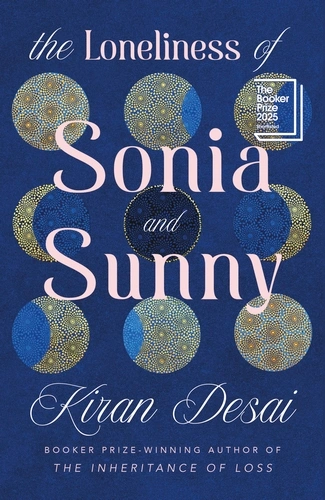
The Loneliness of Sonia and Sunny (Hogarth, 2025), Kiran Desai’s latest book, took twenty years to write. The result is a book of incredible personality and style, one that is delicious proof of a deeply unique imagination. The story and characters have been steeped in Desai’s particular sensibility. Loneliness is less a traditional novel and more an inventive meander through the intertwined lives of Sonia Shah and Sunny Bhatia, their parents and the peculiar impetuses that push and pull them through the years. It’s difficult to pin it down.
Desai’s writing is deft, the work of a seasoned imagination, employing playful turns of idiomatic phrase that are absolutely unique. For a desi reader, the tone is immediately recognisable. Sunny’s mother, widowed Babita Bhatia, is a classic aunty from Panchsheel Park, the Lahore equivalent of old Gulberg; a khandani sort with her silk saris, matching ‘tops’ (the earrings, not the clothes) and a tiny dog. She is the kind of woman who wears ‘court shoes’ and would never dream of imposing herself on her journalist-working-in-New-York son except to call him every day, and want to join him on his holidays. And ban him from talking to his dirty scoundrel uncles, who have been locked in a fight over the family house with their sister-in-law ever since their brother died.
What is most pleasing about Desai’s long-anticipated novel is how it skirts whimsy and idiom, but never tips into anything that could be accused of being typical or ethnic. The prose is sprightly, thoughtful and surprising, even as it weaves its way through its characters’ thoughts and actions in an oddly plotted fashion.
The arc of the book begins, as all good desi stories do, with two sets of grandparents, one belonging to Sonia and one to Sunny. There is a feud over the Shahs’ khansama, whose superior kebabs are traded between the households, and eventually the idea of an arrangement between the grandchildren. Why are Sonia and Sunny lonely? The story is as much about loneliness as it is about the ways in which we puzzle out a life beneath its shadow, caught between desire and fear.
What is most pleasing about Desai’s long-anticipated novel is how it skirts whimsy and idiom, but never tips into anything that could be accused of being typical or ethnic. The prose is sprightly, thoughtful and surprising, even as it weaves its way through its characters’ thoughts and actions in an oddly plotted fashion. This is a story that artfully dodges logical progression. If anything is whimsical, it is the narrative arc, at best a loose collection of events and at worst a slightly baffling progression of ideas, led by the nose by temperamental characters — in itself not a fault, or an impediment to the enjoyment of the novel.
With The Loneliness of Sonia and Sunny, Kiran Desai has done something remarkable. She has made a world of her own, with a language and style all hers. It is a deeply feminine book, going whole-heartedly into the question of a woman’s place in both the larger world and her inner one, as evidenced by Seher Shah (Sonia’s mother) and Babita Bhatia’s lives, as well as…well, every woman’s in the book. Where does one belong? Where do you go when you don’t fit into any of the moulds prescribed for you, not because you were trying to escape them, but you just found yourself outside of them?
From the lives of Sonia’s spinster aunt Mina Foi to Sonia herself, from the preoccupations of the Bhatia maids Vini-Puni to Babita’s widowed friend in Goa, Vanya — the book is full of very real, female worries of safety and home, of love and support, of the private traps we (especially women) find ourselves in. Babita’s husband died early; Sonia is entangled in a disastrous love affair with a hideous man; Seher’s marriage has grown too tight — what do you have to give up, in order to live?
The story moves between the psyche and reality, in a fashion reminiscent of D. H. Lawrence, almost gothic in its representation of inner turmoil as a real physical threat. Is a wicked man also a demon? Is being haunted in your spirit also the same as being physically possessed? Everything is normal in this world. Everything is important. These questions and responses are presented as real, with sympathy and a wry understanding.
Of course your inner darkness will spill out of you. Of course you will do things that make no sense to anyone, and you cannot explain them, and that is just the fact of being human. Desai’s writing is a masterclass in narrative voice and personality.
Is The Loneliness of Sonia and Sunny a romance? One would hope so, given that it begins with a rishta. It’s certainly about love: the presence of it, the hope of it, the disaster of it, the absence of it. The book is judicious: it’s not just a story about young people muddling through, it’s about their elders doing the same. It’s a book that lives like normal people, and frets and obsesses and magnifies and hyperboles itself through almost seven hundred pages. It may sound incredible, but it is a thoroughly absorbing, hugely entertaining, good old yarn of a tale, at once familiar and bemusing.

Mina Malik is a writer and poet based in Lahore. She is the co-founder of The Peepul Press and prose editor at The Aleph Review.