I’ll never forget the first wedding I attended as a new mother, three months postpartum, squashed into a heavy jora from my bari (it was a wedding on my husband’s side of the family), carrying around a colicky baby who screamed at every new face she saw.
That wedding (comprising eight events out of which I attended four) convinced me that Pakistan must really hate mothers. Everyone insisted I attend, and then kept asking me why my baby wouldn’t stop crying despite all the wonderfully loud music. I couldn’t find any private spaces to breastfeed, change diapers, or even a quiet corner to give her a break from all the noise.
By the time an aunty took pity on my husband and I, and took the baby for a few minutes so she could chivy us onto the stage for the doodh pilai, I was done. I had thought this would be easier. I had assumed that all the women who had been so interested in me procreating would at least want to take turns holding the result for 10 minutes, and giving me a break.
The experience, funnily enough, reminded me of another wedding: my khala’s, in the 90s. I was five, and featured heavily in the amateur, unedited, home video of her nikkah and barat. I share the frame with my mother for only a few minutes (loudly demanding a balloon during the reading of the nikkah). For the rest of the film, I am being led by the hand by one of her aunts. Every rewatch surprises me. I have never left my own children alone with anyone except my husband and my mother. I stopped working when my first was born because childcare and travel would eat up whatever money I’d earn. Thus began life as long stretches of time full of nothing but relentless childcare, of scheduling showers around my husband’s office hours, while envying his ability to simply leave and do other things with no planning required. No one else seemed reliable, available, concerned, or close. It is one of the reasons that I decided to stop at two children; I simply couldn’t stomach potty-training a third.
Yet, just a generation ago, my mother relied on relatives long enough to lose track of her own kids at a crowded wedding. I’ve been bathed by aunts, spent nights away with grandmothers, and been left to fend for myself with second cousins. It is probably why she thinks nothing of dropping little hints now that my second is a year old, about how the whorl on his head means the next one will be a son. After raising two kids with minimal support, though, the assumption that there will inevitably be a third feels like a microaggression
It is hard for me, a woman who can order condoms off Daraz and walk into any pharmacy for the pill (albeit red-faced, this is Pakistan after all), to imagine pregnancy and childbirth as inevitable. Just endless children piling on top of each other, outrunning stagnant salaries as well as my own capacity to offer love, support, and emotional regulation.
My mother’s network didn’t grow out of nothing. Its foundations were set by her mother, my grandmother, when she married into a multi-generational, multi-family home, obediently slotting herself into a load-bearing section of the machinery that kept it running. If multiple sisters and mothers-in-law were available to watch the children, give advice, knit wardrobes, and add to trousseaus, then their husbands decided how those children would be raised. My grandfather’s paychecks went into the shared family budget. If something could not be purchased in bulk for the entire family (at least for all the dozens of children), then it would not be purchased at all. My mother and aunts lived like the children in the popular TV drama Jama Taqseem, relying on their mamus for Eid clothes and occasional treats.
My grandmother spent years slaving in the kitchen. She still tells stories of making over 40 rotis per meal, cooking through major illnesses, having her things constantly used without permission, and having to navigate complex family relationships largely without the support of her husband. Her memories are a strange mix of resentment and indebtedness, sisterhood and alienation.
My mother did her best to maintain these family ties, attending every wedding and funeral, every majlis and niyaz, every bismillah and birthday. When my family lived in the Gulf and we visited Pakistan every 2 years, my siblings and I were incredibly resentful of the obligatory check-ins with her aunts and uncles, now all scattered, with the family house becoming disputed property. When incomes had diverged, and younger deweranis refused to follow the rules that kept the joint family machine operational, my grandparents eventually moved out of the shared home. The split was not amicable. But apparently, in “good families”, fights are not supposed to transfer down to subsequent generations.

Around my teens, these social niceties began to feel hollow and one-sided. The endless visits turned holidays into an exhausting parade from house to house, feigning a respect I did not feel. These relatives, in turn, felt no need to visit a younger niece, or ask if she needed anything, once they did not live in the same house as her mother.
The “male loneliness epidemic” has failed to raise sufficient alarm, so scholars, pundits, and CEOs around the world have started to beat a brand-new gong. Birthrates are falling, especially in developed countries, signaling a future crisis in labor, economic innovation, and public spending. The fear is not without merit. Global fertility has fallen from five births per woman in the 70s to 2.25, skating dangerously close to replacement levels. The trends appear universal across the board, with steeper declines in East Asian countries such as Japan and Korea, as well as across Europe (a total fertility rate of 1.38 in 2023). Experts point to a number of factors, including women’s greater access to education, reliable contraception, and the tinkle of glass ceilings breaking left and right as women have pushed into jobs that pay an actual salary. In more patriarchal countries like Japan and South Korea, where men are stubbornly refusing to share the load of imagined leadership in the home with women who increasingly out-earn and out-personality them, the declines are steeper. But even in more progressive countries and among more relaxed generations (millennial fathers are the most involved since involved fathers became a concept), when given the choice between changing diapers for eight hours a day by yourself and doing anything else, women are, unsurprisingly, opting for anything else.
Various right-wing commentators insist it all went wrong with women’s suffrage and the rise of feminism, but other cultural and economic shifts may have played a greater role. It is hard for me, a woman who can order condoms off Daraz and walk into any pharmacy for the pill (albeit red-faced, this is Pakistan after all), to imagine pregnancy and childbirth as inevitable. Just endless children piling on top of each other, outrunning stagnant salaries as well as my own capacity to offer love, support, and emotional regulation.
Pakistan still sits at a comfortable birthrate of 3.14, a steep decline from 6 in the 1950s, but still higher than the global average. After growing up with repeated warnings of the liability of a population bomb on national television, it feels strange when the latest international reports describe this rising population as a massive opportunity in terms of increased labor, a vigorous workforce, and an innovative youth bulge.
Anecdotally, if I know ten (middle to upper-middle class, university educated) couples my age, then maybe two have or want a third child. Most are happy with a pair, citing the rising costs of maintaining their lifestyle, future uncertainty around higher education, jobs, climate change and global stability, and the increasing difficulty in migrating to better economies (as those better economies stagnate or implode in real time). The women tell me they want to get through the baby stage, put the kids in schools and get on with their lives.
I am also seeing something that I would never mention to my mother: couples who do not want children at all. They do not feel ready for responsibility, wish to change the way they live, or think they are or will ever be stable enough to bring children into this world. One of my friends, for example, feels she is not suited to the task of nurturing a child, giving them the emotional support they will need through childhood, teens, and early adulthood.
The women who choose to have children while continuing to work (Pakistan offers only 3 months of paid maternity leave by law), rely on either private or government daycares, househelp (where does the househelp leave her children?), or the more logistically reliable (though often emotionally volatile) care of a maternal grandmother. They juggle complicated commutes, more grueling routines, and extra prep so they can continue to cultivate nascent careers or take as short a break from paid work as possible.
It isn't just that families are no longer living under the same roof; they are now scattered across cities and countries, reducing contact between siblings and cousins to calls online, social media follows, and groupchats. You can’t watch someone's toddler over WhatsApp, after all. As these social safety nets have unravelled, infrastructure has not kept pace to replace them.
In-laws, though, haven't changed much since my mother’s time. The paternal family does not tend to subscribe to the delicate social contract that stipulates a steady supply of progeny for some help in raising them. Daadis seem to figure less frequently than naanis in the complex management of young families. Still, the social structures that allowed my mother to rely on a network of sisters, chachis, and phuphos to give her a break have eroded beyond her own family as well.
While there is little solid data, there appears to be a general consensus that the joint family system is slowly unraveling in urban areas. The traditional setup of multiple brothers and their families living in a single home with the family elders is slowly being replaced by smaller structures of a couple, the parents of one (typically the man), and the couple’s children living together, with the parents sometimes shuttling between children, if they have more than one capable of taking care of them.
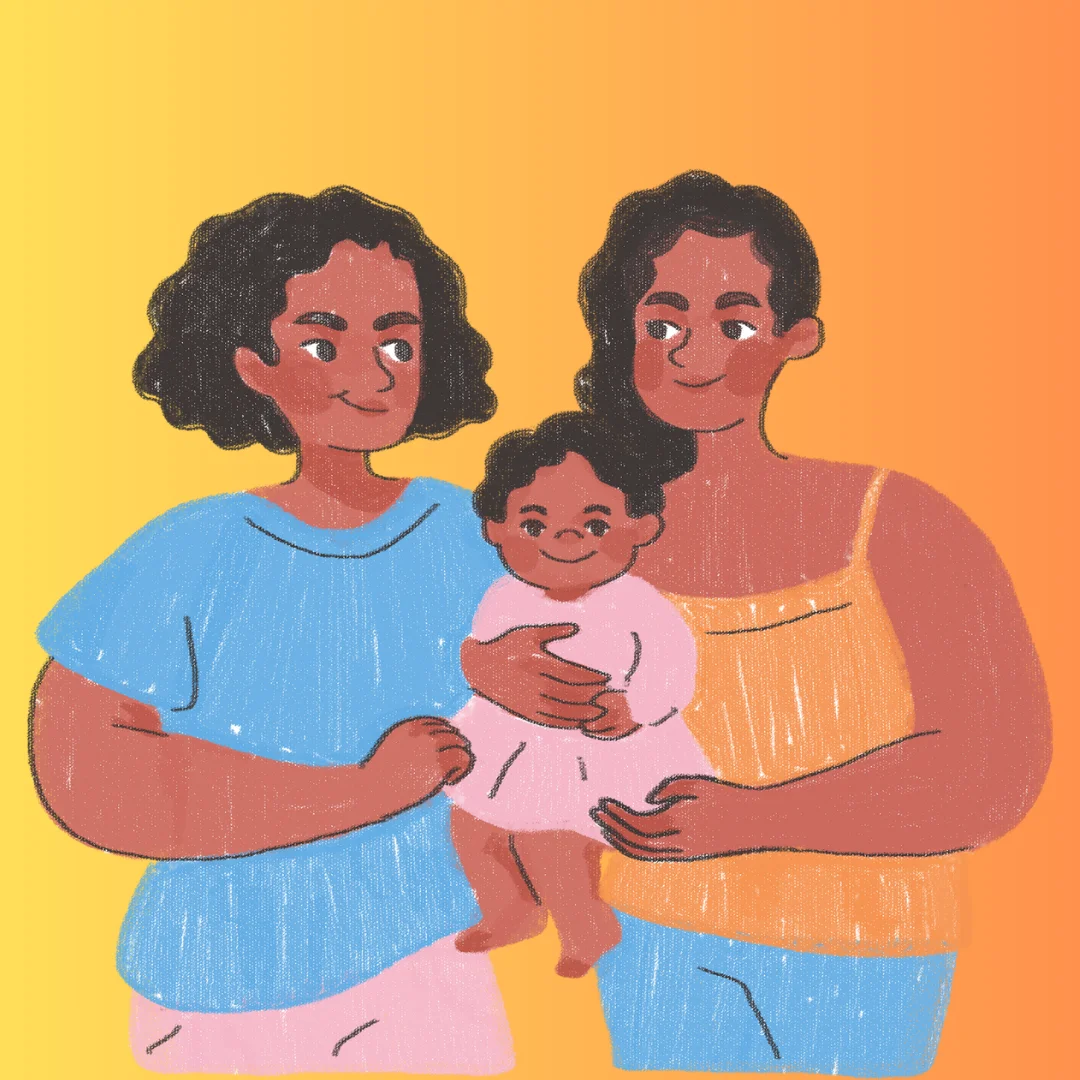
It isn't just that families are no longer living under the same roof; they are now scattered across cities and countries, reducing contact between siblings and cousins to calls online, social media follows, and groupchats. You can’t watch someone's toddler over WhatsApp, after all. As these social safety nets have unravelled, infrastructure has not kept pace to replace them. Something as basic as a clear, wide sidewalk to maneuver one’s heavily pregnant form over is a rarity. Public bathrooms are biohazards. Public places are crowded, largely inaccessible for strollers and wheelchairs, and lack basics such as changing tables and breastfeeding stations. Some, like the breastfeeding cabins installed at the Allama Iqbal Airport in 2020, feel like publicity stunts rather than something actually designed to be utilised. The staff at Packages Mall, for example, keep those rooms locked because people like to shut themselves in for selfies or other questionable activities.
Parks and rare third spaces are rapidly being swallowed up by parking lots and ticketed padel courts. Those kids playing cricket on the street? Well, that’s because we’ve paved over their natural habitat, the place where they could get into trouble without the danger of being run over by cars, or falling into manholes and drowning in raw sewage. Another thing that is no longer true about modern, urban life in Pakistani cities is knowing your neighbours. Our parents and grandparents used to be in and out of the nearest houses, but as families move out of ancestral mohallas and pinds and into more genteel housing societies, many do not put down any solid roots in the form of getting to know their immediate community.
When everyone on a cul-de-sac knew everyone else, elders spent their days keeping an eye out for comings and goings, noticing what children were doing, and remarking on sudden changes in routines. If Aunty Pakistan Radio was inclined to immediately tell your mother that you’ve been speaking to a strange boy while you climb out of your school van, she’s also just as likely to tell off your brother for smoking at the khoka or picking fights. An army of retired uncles could be relied upon to interfere in case of strangers loitering or bad behavior. More and more families now live in disconnected silos, meaning that most, if not all, the supervision outside schools falls on the parents.
Daycares are largely unregulated, and the better quality ones are expensive and concentrated in the posher locales of the different DHAs and Gulberg. Many workplaces still do not provide on-site childcare (except perhaps in large government colleges and schools), and poorly implemented policies and laws do little to prevent discrimination against mothers. There is also a thinly veiled vein of resentment against women trying to navigate workplaces and commute in safety (leaving on time, not staying late) that extends to the supposed leniency afforded to women with small children, adding yet another barrier.
This is not to say anything of the various structural issues that also add to the difficulties of having and rearing children in Pakistan, including poor healthcare and abysmal public education, inadequate public transport, deteriorating security, and a political apparatus navigating the perpetual roundabout of delicate turnings. In a country that insists on the sanctity of the family and a woman's essential calling being motherhood, there is laughably little support for families.

For now, culture and religion appear to be the only things keeping the birthrate high.
Still, I like to think that the answer to the problem of continuing the human race lies somewhere on the middle road between the nuclear setup and the horde that is a true desi joint family. The former does not appear to have done well in other parts of the world. Women have found that men make unreliable partners in the business of child-rearing. In more patriarchal cultures, men have dug in their heels, expecting all the respect and adoration of being the sole breadwinner, while also wanting to enjoy a second income, a large family, a personal secretary, and a housekeeper they can sleep with. Women have responded by refusing to have any more children.
Pakistani elders seem not to have caught on to the cultural shifts that are causing their children to move out and abandon procreation. The bahu is asked to endlessly adjust when perhaps the saas and susar should consider a little compromise if they wish for access to their grandchildren. Many refuse to make small changes to routines (earlier bedtimes for school days) or to the overall structure of the home (baby proofing, replacing furniture, and changing the way the house is set up to accommodate growing families). The daughter-in-law is still seen as an interloper, an outsider, rather than a member of the family who requires support. Meanwhile caregiving for the elderly is still expected as couples approach their sandwich years in isolation; two people caring for a set of aging parents as well as growing children.
In other countries, people are slowly realizing that cutting themselves off from a supportive community (no matter how annoying it is in the short run), means separating themselves from the help needed to raise the next generation. Just one example is a recent trend of ‘mommunes’. From China to the United States, women are taking their children and moving in with other mothers, creating found families after modern society and the nuclear setup has failed them. These groups sound very similar to the desi joint family where various dewaranis and jaithanis live with a mother-in-law, take shifts with a new baby, and cook large meals. Minus the multi-generational emotional baggage of course.
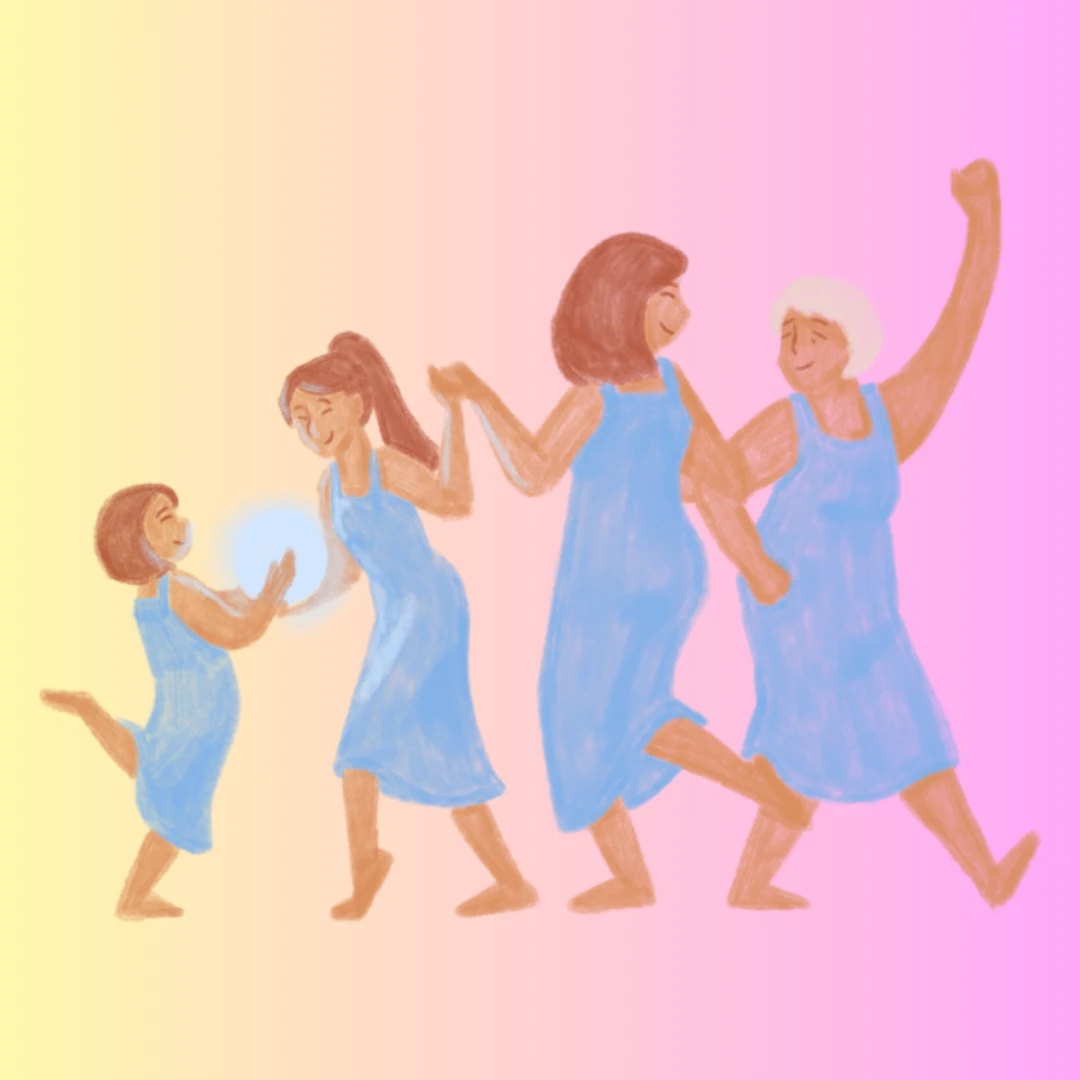
Research suggests that human babies may not actually be a one or even two-person job. Anthropologists studying hunter-gatherer societies around the world have discovered some interesting things about how these societies raise their children: each child is raised by up to 20 caregivers, with at least 8 giving regular hands-on care, such as bathing and feeding. One study even recorded infants being passed between caregivers up to 8 times an hour. Is this how my grandmother raised her children? Is the modern family structure really so alien to the way we have evolved to live?
I visited my khala recently, the one from the wedding video. She lives in another city, but I can’t remember an instance when phone calls between her and my mother do not last hours. As our individual families have seen-sawed between different levels of financial (in)security, we have pooled our resources, stepping in for each other’s children in whatever way we can. We supplement wardrobes, make each other’s doctors appointments, ship textbooks and notes across provincial lines, wire emergency loans, exchange advice, and provide much needed emotional support. My cousins and I vacation in each other's homes, share secrets, help each other make life decisions, endlessly exchange Agatha Christie novels, and make plans to manage each other's parents, cajoling permissions and concessions for each other that we couldn’t get for ourselves.
My khala was at the hospital to receive my firstborn when my mother was isolated with COVID, giving her her first bath, her first feed, and helping my husband coax a post-cesarean fever out of my body. In her home, her daughters do not search for me when my children begin to cry. Instead, they take both of them out into the sun to distract them with fresh flowers, or their own sharp shadows on the ground. Their love for my children feels selfless and reliable, a priceless gift that I find impossible to repay. During my last visit, I left my children with them to go have a leisurely lunch with my mother, the first time we were able to be alone together in four years.

Sakina Hassan is a freelance writer who also writes short fiction and poetry. She is a Salam Award winner, has been longlisted for the Zeenat Haroon Writing Prize, and teaches writing workshops in whatever time is left from caring for her two children. You can find her @kyascenemehjabeen on Instagram.