On March 31, Pakistan Idol announced that it would suspend the remainder of its second season indefinitely, citing “regional tensions” and “calls for national austerity” as reasons why the moment was unsuitable for celebration. Created by British television producer Simon Fuller, the Idol franchise first aired its Pakistani edition on Geo TV from 2013 to 2014. After an eleven-year hiatus, the network confirmed in August 2025 that the programme would return with Bilal Maqsood, Rahat Fateh Ali Khan, Fawad Khan, and Zeb Bangash as judges.
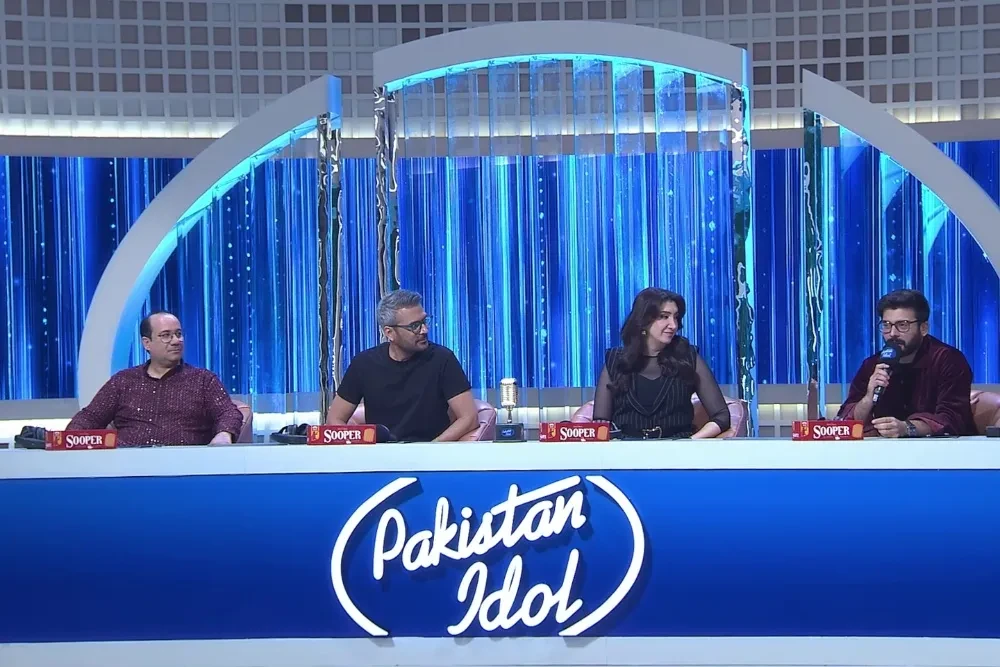
The show’s earlier “pause” for Ramazan had already raised questions about scheduling. One might have expected a cleaner solution, to air decisively before or after, rather than this mid-season interruption that risked dissipating whatever momentum had been built. Whatever interest remained has now been replaced by online speculation about the real reason behind the move.
Even without accounting for the rumored dire straits, the return of Pakistan Idol felt more sobering than promising, its future already shadowed by doubt. Critics like Nofil Naqvi were quick to measure the show’s ambitions against an industry marked less by breakout possibility than by attrition — dwindling resources, fragile infrastructure, and an audience increasingly dispersed across platforms that do not require the mediation of television. That the previous Idol winner has receded into near-anonymity, or that the earlier season bore the visual texture of low-resolution DV, are not oversights so much as conditions the revival appears to have quietly absorbed.
The upgrades this time — cleaner sound, sharper image — are almost beside the point. What the show seems to be betting on instead is circulation: that a performance, once clipped and uploaded, might achieve the afterlife that broadcast alone can no longer secure. Virality, in this sense, becomes a kind of proxy for endurance. At the same time, political tensions have narrowed the musical field, with the stage limited to Pakistani songs; the result is a catalogue that leans heavily on the already consecrated, the familiar loop of “golden hits.”
Originally, the Idol format has depended on a more unruly economy of attention — the rude judge, the disastrous audition, the engineered pathos — to sustain its presence beyond the episode. Pakistan Idol season two, instead, is banking on nostalgia.
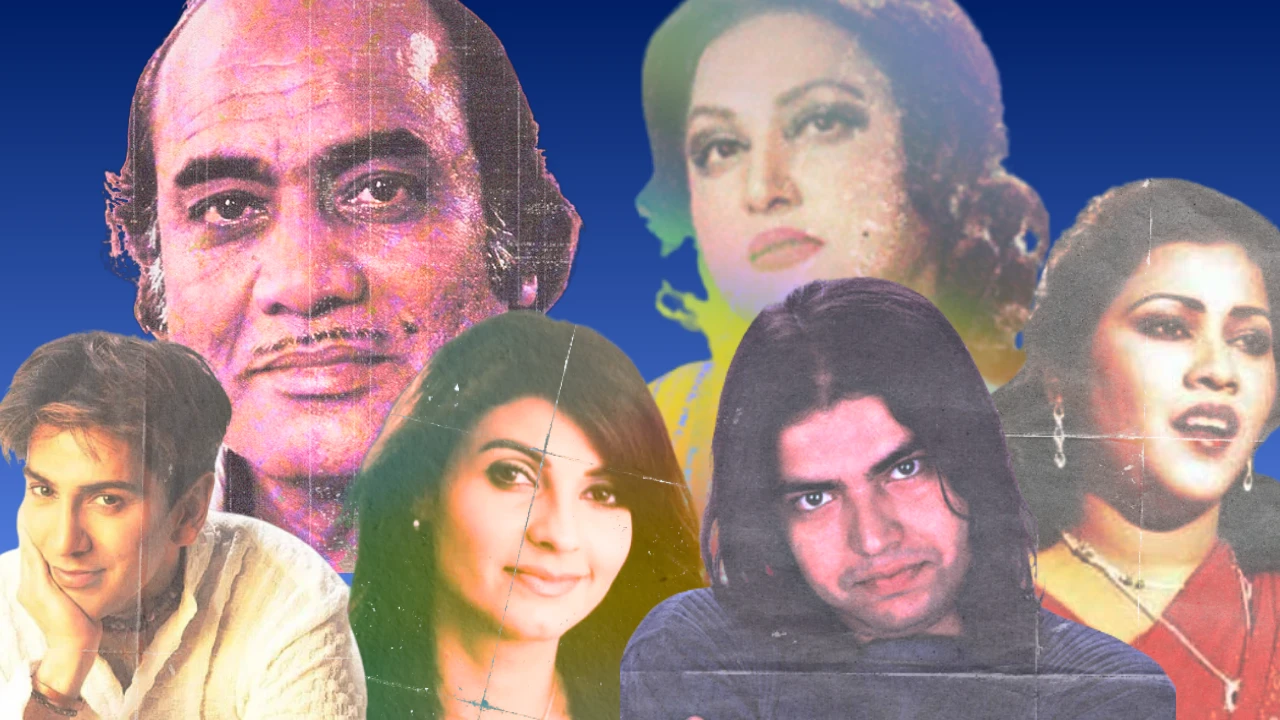
Not that mining the past is inherently misguided. There is something quietly pleasing about Gen Z rediscovering voices like Fariha Parvez, Fakhir, and Ahmad Jahanzeb, even if this supposed market remains too diffuse to cohere into anything like a stable demographic. As with advertisers, producers seem to be working from a negative definition: that whatever Gen Z is listening to must be unlike what came before. And yet, when auditions for Pakistan Idol arrive, the choices are strikingly familiar: classical, filmy, and resolutely canonical.
[Surely] whatever Gen Z is listening to must be unlike what came before. And yet, when auditions for Pakistan Idol arrive, the choices are strikingly familiar: classical, filmy, and resolutely canonical.
That tendency only deepens as the season progresses. Contestants who begin with the repertoires of Noor Jehan, Mehdi Hassan, Ghulam Ali, and Mehnaz move, if at all, toward the pop of the 1990s and 2000s, with only the occasional detour into pop-rock. The overall tenor, however, remains firmly ghazal-oriented. Part of this is structural: ongoing copyright constraints have narrowed the pool further than expected. But even within those limits, the imbalance is notable, less a curatorial choice than a drift the judges themselves did not quite anticipate.
“Honestly, I have grown tired of listening to ghazals. I have never listened to this many ghazals before Pakistan Idol,” Bilal Maqsood remarked with a laugh in one episode, a throwaway line that nonetheless captures the show’s tonal drift. Genre, of course, matters: the ghazal is only one formal tradition among many. But a larger share of performances might be more usefully grouped under the capacious category of the filmy geet. Less a strict form than a function, a song written for and situated within film, regardless of its musical structure.
What is striking is how rarely this ecosystem is discussed in its entirety. The crises of the film and music industries are invoked often enough, but the decline of playback singing, once the connective tissue between them, is seldom foregrounded. Film scholars have long returned to Saadat Hasan Manto’s essay Pakistan Ke Film, which, in mapping the anxieties of post-Partition cinema, underscores the interdependence of writers and filmmakers. If anything, Bollywood offers the clearest counterpoint: a still-functioning nexus in which writers, musicians, performers, and filmmakers sustain one another, rather than fray apart.
Even as older Pakistani cinema remains largely neglected, with little by way of systematic archival or restoration work, it is striking how easily musical giants like Noor Jehan and Mehdi Hassan are severed from the playback infrastructures that produced them, their songs circulating long after the films themselves have faded from view. What Pakistan Idol reveals, then, is not only a scarcity of opportunity in a constricted industry, but the persistence of a particular kind of singer, one whose training and imaginative horizon remain tethered to these canonical figures, whose stature is inseparable from cinema’s own histories.
One might share Maqsood’s candid fatigue, and call, as he does, for newer genres. Such genres do exist, and in abundance. But what is telling is not their absence so much as their limited uptake: that emerging singers continue to reach backward, toward inherited repertoires and familiar icons, rather than even the more recent past of millennial pop and rock. And this tendency cannot be attributed solely to the constraints, or even the ambitions, of the Idol stage.
A parallel observation is just how many aspirants, across class, continue to pursue formal training in music. Watching the national auditions of Pakistan Idol up to the final sixteen, one encountered no shortage of technical lapses: weak breath control, missed notes, occasionally ungainly arrangements. In earlier iterations of the format, such moments might have been mined for ridicule. Here, they are met with a studied gentleness, recasting the show less as a spectacle of elimination than as a kind of academy. Yet as Pakistan Idol narrows to its final seven, the composition of that pool is telling: three contestants are formally trained vocalists (Waqar Hussain, Tarab Nafees, Aryan Naveed), one holds a degree in musicology (Samya Gohar), and another, Maham Tahir, is already a working singer across regional circuits.
Set against this is the enduring fantasy of the DIY singer — the prodigy who, under-resourced and self-made, rises purely on instinct. It is a compelling narrative, and one the format has long depended on. But it also obscures as much as it reveals: not only the absence of robust infrastructure, but the quieter ways in which people route around that absence. However inhospitable the country may appear to the arts, there remains a deep and ongoing investment in music, sustained within families, inherited as both vocation and livelihood, and shaped largely by the continuities of Hindustani classical and folk traditions.
[There is an] enduring fantasy of the DIY singer — the prodigy who, under-resourced and self-made, rises purely on instinct. It is a compelling narrative, and one the format has long depended on.
Idol showrunners may insist that the present moment is more conducive to singing reality television than it was in 2014, but the promise of the algorithm is, at best, unstable.
Consider Rose Mary Mushtaq: classically trained, first seen on Chhote Ustaad in 2010, then a mid-run contestant on Pakistan Idol’s first season, and now returned, years later, in search of something like renewal. Watching her, one senses not progression but suspension. For her audition, she reprises Runa Laila’s “Kaate Na Katte,” the same choice as before, though her voice has deepened and settled.
By her own account, the earlier season offered visibility but little by way of guidance. Even without making it to the top sixteen this time, her return suggests less a failure of individual talent than a broader stasis: a loop in which singers re-enter the same circuits, armed with greater polish but no clearer pathway forward.
Winners of American Idol and Indian Idol walk away with recording contracts and substantial cash prizes; Pakistan Idol may offer similar rewards, but their impact is questionable. It is true that exposure combined with smart networking often matters more than the win itself. Nabeel Shaukat Ali, winner of Sur Kshetra (2012), impressed audiences in both India and Pakistan and went on to release film songs, television OSTs, and make two appearances on Coke Studio. Sara Raza Khan, a finalist on the same show, has followed a comparable path, including a Coke Studio feature. Sara, Nabeel, and Rose Mary all maintain active social media and YouTube accounts alongside private gigs, but none have landed a truly “big break.”
After decades of cinema’s decline, Bollywood became the coveted route to moderate, or even superstar fame, sustaining some hope for a career in filmy geet. Atif Aslam and Rahat Fateh Ali Khan are reminders of this fleeting window. Today, Pakistani singers face no comparable market to absorb the next Mehdi Hassan or Nayyara Noor. Compared to filmy geet, TV OSTs have rarely enjoyed an independent life of their own. Among the few exceptions is Woh Humsafar Tha, performed by Quratul Ain Balouch for Humsafar (2011), a song that continues to define her career. More recently, the 2023 drama Ishq Murshid renewed its own fame through Ahmed Jahanzeb’s Ishq Murshid Mera, granting the still-iconic singer a second life in the churn of online popularity.
Yet other notable cases—Sajjad Ali’s opening song for Ashk (2012), Rahat Fateh Ali Khan’s for Sadqay Tumharay (2014), and Hadiqa Kiani’s for Udaari (2016)—seldom register among the best or most successful work of their respective singers. The symbiosis between OST singing and television entertainment proves mutually productive only under specific conditions: a popular singer, a widely watched cast, and a powerful channel. Absent this alignment, obscure dramas rarely catapult singers to success. Even widely remembered serials often leave behind OSTs that fade from public memory, resurfacing only in the sedimented nostalgia of YouTube playlists.
Today, Pakistani singers face no comparable market to absorb the next Mehdi Hassan or Nayyara Noor.
In place of a sustainable market, platforms like Pakistan Idol, much like the artists they showcase, have begun to rely on the dubious, ever-shifting operations of the feed. In the same episode, after lamenting the glut of ghazals on the show, Maqsood tells Rohail Asghar to pick something more popular, more nostalgic, something the audience can actually connect with, instead of Mehdi Hassan’s Aap Ko Bhool Jayein Hum.
“If you must sing a ghazal, choose one that is very close to the public’s heart. People aren’t familiar with your current choice.”
This is only practical advice. If the winner’s fate hinges on nostalgia, audiences may as well be voting for the song, not the contestant.
Manahil Tahira is a Karachi-based journalist and writer whose work moves between fiction and nonfiction, tracing the intersections of bodies, spaces, visuality and technology. Formerly desk head of Lifestyle at The Express Tribune, their creative writing has appeared in Arzu Anthology, Fahmidan Journal, Lakeer, and is forthcoming in The Aleph Review (2025). They are also a Non-Fiction Editor at South Asian Avant-Garde (SAAG) magazine.